Meal Planning & Household Economics
Most batch cooking systems fail for the same reason diets fail: they demand a Sunday that doesn’t exist. Here’s a version built around the Sunday you actually have.
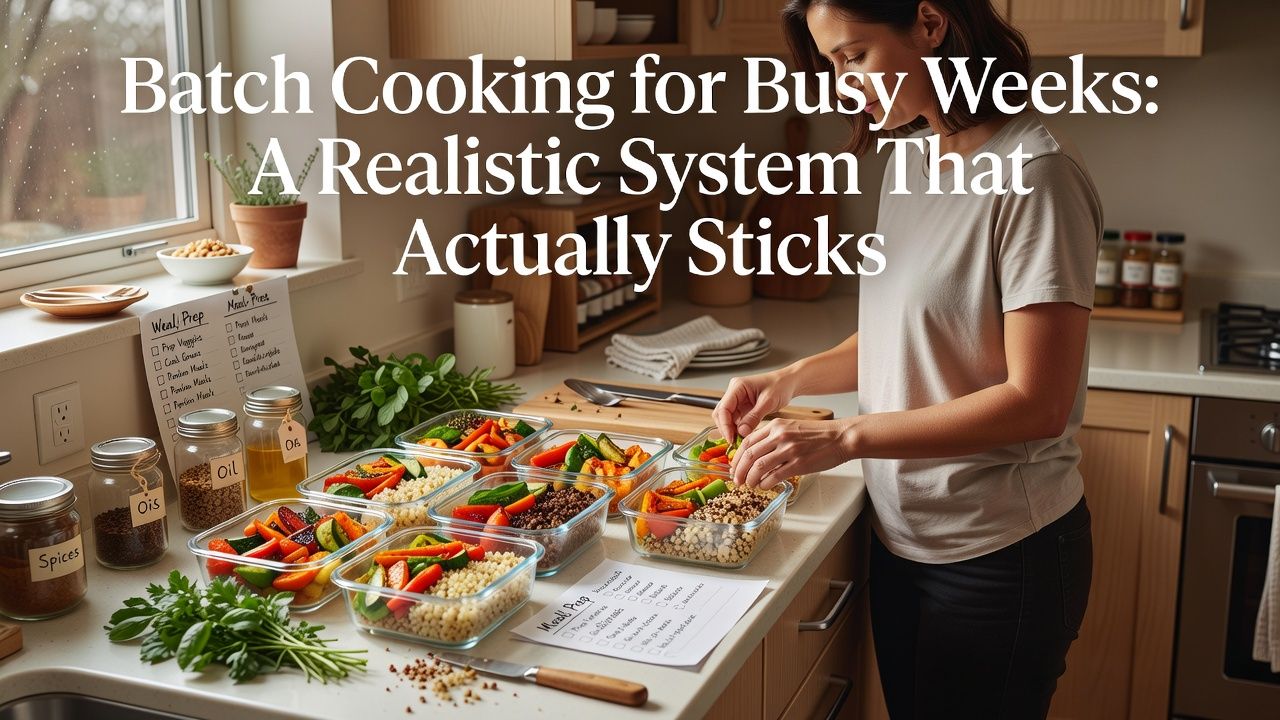
Search for batch cooking advice and you’ll find a familiar image: an immaculate kitchen counter lined with a dozen identical glass containers, each holding a precisely portioned meal, photographed under perfect light on a Sunday afternoon that apparently had four uninterrupted hours available for cooking. For a meaningful share of people who try to adopt this system, it lasts two or three weeks before collapsing, and the collapse gets quietly blamed on personal discipline rather than on the system itself. That’s usually the wrong diagnosis. The system was built around an idealized Sunday that most households don’t actually have, and it fails predictably when real life — a sick kid, a long work week, simple exhaustion — interrupts it even once, at which point the whole elaborate structure falls apart because there was never a plan for what happens when the perfect session doesn’t materialize.
A batch cooking system that actually survives contact with a real week needs to be built differently: around components rather than finished meals, with genuine flexibility for the inevitable week where the full session doesn’t happen, and calibrated to a realistic time budget rather than an aspirational one borrowed from someone else’s very different life circumstances. This guide lays out that version, not because the container-lined-counter approach is wrong for everyone, but because a system that works when everything goes right and collapses the first time it doesn’t is a fundamentally worse system than one that bends without breaking under ordinary, predictable pressure.
01Components, not finished meals
The single most important structural decision in a durable batch cooking system is choosing to batch-cook components — a protein, a grain, a sauce, a set of roasted vegetables — rather than fully assembled, identical meals meant to be reheated as-is night after night. The reason is boredom management as much as anything practical: seven identical containers of the same finished dish is a genuinely hard thing to eat through with any enthusiasm by Thursday, and the collapse of many batch cooking attempts traces directly to this fatigue rather than to lack of time or effort at the cooking stage itself. Components solve this because the same batch of cooked chicken thighs, roasted vegetables, and cooked grain can become a grain bowl on Monday, a wrap on Tuesday, a quick stir-fry on Wednesday, and a salad topping on Thursday, four different-feeling meals from one cooking session, rather than one meal repeated four times in a row until nobody wants to see it again.
This approach also has a practical resilience advantage over fully assembled meals: if plans change mid-week, you’re invited out, someone brings home takeout, a component gets used differently than originally planned, nothing is wasted, because the components are flexible building blocks rather than a fixed, sequenced meal plan that falls apart the moment one day doesn’t go as scripted in advance. A useful mental model is to think of the batch cooking session as stocking a pantry of ready-to-use ingredients rather than pre-cooking a week’s worth of dinners; the actual “cooking” that happens on a Tuesday night is fast assembly, not starting from raw ingredients, but it’s still genuine assembly rather than simply reheating a single locked-in dish that was decided upon days earlier.
| Component type | Batch-cook once | Becomes |
|---|---|---|
| Protein | Roast or sear a large batch, simply seasoned | Bowls, wraps, salads, quick stir-fries |
| Grain | Cook a large pot of rice, quinoa, or similar | A base for almost anything above |
| Roasted vegetables | One or two full sheet pans | Bowls, omelets, pasta, sandwich fillings |
| Beans or legumes | A large pot from dried, or several tins | Soups, salads, dips, bowls |
| Sauce or dressing | One batch, several variations | Ties everything above together, changes flavor daily |
| Chopped aromatics | Onion, garlic, ginger prepped in bulk | The start of any weeknight cooking, saved time daily |
02The realistic time budget
The four-hour Sunday session that batch cooking media so often depicts is genuinely achievable for some households and genuinely unrealistic for many others, and building a system around the wrong assumption for your own specific circumstances is a primary reason these systems collapse within a few attempts. A more durable approach treats ninety minutes as the standard target, enough time to prep and cook two or three components properly, with the explicit understanding that this is a floor, not a ceiling: some weeks there’s more time and more gets done, some weeks there’s less and the session gets shortened or skipped entirely, and neither outcome is a failure of the underlying system, just a normal variation within it.
The parallel-cooking principle is what makes ninety minutes genuinely productive rather than a rushed compromise: while a protein roasts in the oven and a pot of grain simmers on the stove, unattended, the active hands-on time is actually spent chopping vegetables for the next component or making a sauce, so that oven time and stovetop time and prep time overlap rather than happening in strict sequence one after another. A loose but genuinely useful timeline: start the oven and get the protein in first, since it typically needs the longest unattended cook time; start the grain next, since it too can largely be left alone once the water’s boiling; use the parallel unattended time to prep and roast vegetables or make a sauce; and finish with quick assembly tasks like washing salad greens or portioning items into containers while everything else finishes cooking on its own. Working this way, a ninety-minute session can genuinely produce three to four components, which is enough raw material for most of a week’s dinners once combined in different ways across different nights.
The missed-week rule
Decide in advance what happens when the batch session gets skipped entirely, because it will, eventually. The answer should already exist before it happens: a short list of genuinely fast backup meals (eggs and toast, a can of beans and greens, a simple pasta) that require no batch-cooked components at all. A system without a built-in answer for a missed week tends to be abandoned the first time one happens.
03Choosing what to actually batch-cook
Not every dish reheats well, and choosing components that genuinely hold up over three to five days in the fridge is worth more planning attention than most first attempts at this system tend to give it. Roasted vegetables, cooked grains, braised or roasted proteins, beans, and most sauces and dressings hold their texture and flavor well across the week without much noticeable decline. Anything fried loses its crispness within hours and is a poor batch-cooking candidate unless you’re prepared to re-crisp it briefly before serving each time, which somewhat defeats the point of batching it in the first place. Delicate leafy greens wilt and are better added fresh at the point of assembly rather than pre-mixed into a stored component that then has to be eaten before the greens turn. Pasta, if batch-cooked, benefits from being slightly underdone and tossed with a little oil to prevent clumping, since it continues to soften somewhat in storage and reheating and can turn mushy if it was fully cooked to begin with.
Seasoning strategy matters as much as the choice of ingredient itself. Batch-cooked proteins and grains are generally better kept relatively simply seasoned at the cooking stage, salt, pepper, a base aromatic or two, with the bolder, more specific flavors, a particular spice blend, a sauce, fresh herbs, added at the point of assembly rather than baked into the entire batch from the start. This is what actually enables the same roasted chicken to become a Mexican-inspired bowl one night and a Mediterranean-inspired salad the next, since the base component stays neutral enough to take on different flavor directions depending on what’s added at serving time rather than being locked into one flavor profile from the moment it left the oven. Batching two or three different sauces or dressings in the same session, each one takes only a few minutes and most keep well for a week, is one of the most efficient ways to generate real variety from a genuinely small number of base components.
04Storage that actually keeps food good and safe
Getting storage right is both a quality issue, food that still tastes good on day four, and a genuine safety issue, and it’s worth treating both seriously rather than assuming any container and any timeline is automatically fine. Cool cooked food reasonably promptly rather than leaving it out at room temperature for extended periods after cooking, and divide large batches of hot food into smaller, shallower containers before refrigerating, since a large deep pot of hot food cools slowly in the center even inside a refrigerator, passing more time in a temperature range where bacteria multiply readily than a shallower portion would. Current guidance on safe cooling times and storage temperatures for cooked food is published at FoodSafety.gov and by the USDA Food Safety and Inspection Service, and it’s genuinely worth a few minutes’ read for anyone cooking and storing food in the quantities batch cooking involves on a regular basis.
As a general guide, most cooked components are best used within about three to four days from the refrigerator, and label everything with the date it was cooked, since a week of overlapping components without labels is a genuine source of both waste, throwing out something perfectly good because you’re not sure how old it is, and, more rarely, of eating something past its safe window because you assumed it was more recent than it actually was. For anything you clearly won’t get through within that window, freezing is the better choice made proactively at the batch-cooking stage rather than a rescue attempt for something that’s already sat too long in the fridge; portion and freeze from day one what you realistically won’t eat within four days, rather than waiting to see what’s left over and hoping it’s still fine by then.
Container choice affects both convenience and food quality more than it might seem at first glance. Glass containers reheat evenly in a microwave or oven without concern about chemicals leaching from plastic, and they don’t stain or hold onto odors the way some plastics do over repeated use, but they’re heavier, can break, and cost more upfront. Good-quality plastic containers are lighter and cheaper but degrade over time, particularly with certain acidic or oily foods, and are worth replacing periodically rather than using indefinitely once they’re stained, warped, or no longer sealing properly against leaks. Whatever the material, uniform, stackable shapes make dramatically better use of limited fridge space than a mismatched collection of odd-sized containers accumulated over the years, and it’s worth standardizing on one or two container sizes specifically for this purpose rather than using whatever happens to be in the cupboard at any given moment.
05A sample session, from components to a week of meals
A concrete example makes the component approach easier to picture in practice rather than in the abstract. In roughly ninety minutes: roast a large tray of chicken thighs, seasoned simply with salt, pepper, and a little oil; cook a large pot of rice or another grain; roast a full sheet pan of mixed vegetables suited to the season; cook a pot of beans or open a few tins and season them lightly; and make two quick sauces, something like a yogurt-and-herb sauce and a simple vinaigrette or chili-oil style dressing, each taking only a few minutes to put together from ingredients you likely already have on hand.
From those five components, a realistic week might look like this: Monday, a grain bowl with chicken, roasted vegetables, and the yogurt sauce; Tuesday, the same chicken shredded into a wrap with beans and the vinaigrette-style dressing; Wednesday, a quick stir-fry using the vegetables and a portion of the beans with fresh garlic and ginger added at cooking time for a genuinely different flavor direction entirely; Thursday, a grain-and-bean salad with fresh greens added at the table and the yogurt sauce as dressing; Friday, whatever’s left combined loosely into a frittata or a simple soup, using up remnants before the weekend arrives and the whole cycle starts again. Five distinct-feeling meals from one cooking session, none of them identical to each other despite sharing the same underlying components, and each night’s actual cooking time is closer to fifteen minutes of assembly than a full cooking session started entirely from scratch.
06Equipment that actually helps a ninety-minute session
A few pieces of equipment genuinely make the parallel-cooking approach easier to execute within the realistic time budget, though none of them are strictly required to get started. Two sheet pans rather than one let you roast a protein and a tray of vegetables simultaneously in the same oven, rather than staggering them in sequence and eating into the total session time. A large pot with a heavy base cooks grains and beans more evenly and with less risk of scorching on the bottom while your attention is elsewhere prepping the next component, which matters more than it sounds like it should when you’re deliberately trying to leave things unattended for stretches.
A reasonably sharp knife and one large cutting board make the active chopping portions of the session meaningfully faster, and it’s worth having enough small bowls or containers on hand to hold prepped vegetables and aromatics as you work through them, rather than creating a pile on the cutting board that has to be cleared before the next item can be tackled. None of this is about buying new equipment specifically for batch cooking; it’s about recognizing which of the tools already in most kitchens genuinely reduce the friction of a ninety-minute session, and making sure those specific items are clean and accessible before the session begins rather than buried at the back of a cupboard.
07Making the system durable over months, not just weeks
The gap between a batch cooking system that lasts a few weeks and one that becomes a genuine, durable habit usually comes down to a handful of structural decisions rather than raw willpower or discipline alone. Rotate the base components rather than repeating the exact same three every single week, different proteins, different grains, different vegetables depending on the season and what’s affordable at the time, using the same underlying structure with different specific ingredients, which prevents the sense of eating the same thing on repeat that undermines many attempts even when the meals are technically varied in their final assembly. Keep a running, honest list of which combinations your household actually enjoyed and which fell flat, since this removes decision fatigue from future planning sessions and steadily improves the system’s real-world success rate over time rather than starting from scratch with a blank slate every single week.
Build in the explicit permission, discussed above, to skip a week entirely without treating it as system failure, and have a genuinely fast backup plan ready for exactly those weeks so the whole approach doesn’t collapse the moment it’s tested by real life. And resist the pressure, often self-imposed from seeing other people’s photographed systems online, to make the process more elaborate or more visually impressive than it actually needs to be. A system built around five component types stored in whatever containers you already own, assembled into different combinations through the week, delivers nearly all of the real benefit of batch cooking, less daily decision-making, less daily active cooking time, less food waste from unused ingredients, without the fragility of a system that only works when a perfect, uninterrupted Sunday actually happens to materialize. The goal was never a beautiful photograph of a full fridge. It was a Tuesday night where dinner takes fifteen minutes instead of an hour, and that goal is achievable on a realistic time budget, built around real components, with real permission to occasionally skip the session altogether without guilt.