Food, Health & Wellness
Sugar does more than sweeten — it browns, balances acidity, and adds body. Cutting it isn’t a single swap; it’s understanding which of those jobs you actually need to replace.
Before anything about technique, a note on framing: this article is about reducing added sugar in everyday home cooking for people who want to, for whatever personal reason, taste preference, general dietary goals, a doctor’s specific guidance, or simple curiosity about how much sugar in a given recipe is really doing there in the first place. It isn’t a call to eliminate sugar entirely or to treat sugar as something to fear; sugar in reasonable amounts, as part of an overall balanced way of eating, is a normal and enjoyable part of food for the vast majority of people, and there’s no need to approach it with anxiety or moral judgment. If you’re managing a specific medical condition like diabetes, or if your relationship with food and eating feels complicated in ways beyond a simple culinary preference, please work directly with a doctor or registered dietitian rather than a cooking article, that’s genuinely the right resource for those situations, and this piece isn’t equipped to replace it.
With that framing in place, the actual cooking problem is genuinely interesting: sugar in a recipe is rarely doing just one job, and understanding which specific job it’s performing in any given dish is the key to reducing it successfully rather than producing a flat, disappointing result nobody wants to eat. Sugar sweetens, obviously, but it also browns, through caramelization and the Maillard reaction, balances acidity and bitterness, adds moisture and tenderness in baking, and provides bulk and texture that a simple sweetness-only substitute often can’t replace on its own. Reducing sugar successfully means identifying which of these jobs matters in a specific recipe and addressing that job specifically, rather than applying one universal swap to every situation and being surprised when it doesn’t work the same way in a caramel as it does in a cup of tea.
01The five jobs sugar actually does
Sweetness is the obvious job and the easiest to address directly, since taste perception is genuinely adjustable, more on that below. But sugar’s other roles are less obvious and more likely to trip up a naive reduction attempt made without understanding what’s actually being lost. In baking specifically, sugar contributes real structural and textural functions beyond taste: it holds moisture, contributing to a tender, moist crumb rather than a dry one, it affects how much a baked good spreads and browns in the oven as it bakes, and in some preparations it plays a genuine structural role in things like meringues or caramelized textures that can’t simply be swapped for a non-caloric sweetener without a real, noticeable change in the finished outcome.
Sugar also performs a genuine flavor-balancing role that has nothing to do with making something taste sweet: a pinch of sugar in a tomato sauce, a pot of chili, or a vinaigrette rounds out acidity and bitterness, making the whole dish taste more balanced without necessarily registering as “sweet” at all to the person eating it, this is a use of sugar as a seasoning tool rather than as a primary flavor, closer in function to how salt is used in savory cooking than to how sugar is used in a dessert. And in browning, caramelization specifically, and to some extent the Maillard reaction as well, sugar is the literal chemical substrate that produces color and complex, roasted flavor; a marinade or glaze reduced in sugar will brown less and taste flatter and less complex, not just less sweet, because the chemistry that produces that specific flavor and color depends on the sugar actually being present in sufficient quantity to react under heat.
| Sugar’s job | Where it matters most | Reducing it changes |
|---|---|---|
| Sweetness | Desserts, drinks, sweet sauces | Perceived sweetness — genuinely adjustable |
| Balancing acid/bitterness | Tomato sauce, dressings, savory dishes | Overall balance, not sweetness per se |
| Moisture & tenderness | Cakes, muffins, quick breads | Texture — can turn dry or tough |
| Browning | Glazes, marinades, baked goods, roasted vegetables | Color and complex flavor, not just sweetness |
| Structure | Meringues, caramel, some candy | Can fail structurally, not just taste different |
02Taste adaptation: the genuinely good news
Here is the most encouraging and least widely known fact about reducing sugar intake: taste perception genuinely adapts over a period of weeks, not months or years as many people assume when they’ve tried and failed to cut back before. A gradual reduction in the sweetness of the food and drink someone regularly consumes leads, over a matter of a few weeks, to a recalibrated baseline where foods that used to taste appropriately sweet start to taste distinctly, sometimes unpleasantly, oversweet, while a level of sweetness that initially seemed underwhelming starts to taste normal and satisfying in its own right. This is a genuine physiological adaptation, not just a matter of willpower or getting used to deprivation through sheer force of will, and it’s the mechanism that makes gradual sugar reduction dramatically more sustainable than an abrupt, drastic cut attempted all at once.
The practical implication is to reduce gradually rather than dramatically all at once: cutting the sugar in a regular recipe by roughly ten to twenty-five percent at a time, giving your palate a few weeks to adjust before cutting further, works far better and feels far less like deprivation than an abrupt fifty-percent cut attempted in a single step that shocks the system and often leads to abandoning the whole effort. This applies to drinks as much as to cooked food, and coffee, tea, and similar regularly consumed beverages are often the easiest and most impactful place to start this gradual process, since they’re consumed frequently enough that the adaptation happens relatively quickly and the cumulative effect across many cups or glasses per week is genuinely significant over the course of a month or two.
Start with what you drink
Coffee, tea, and other regularly sweetened drinks are the easiest place to practice gradual reduction, since the adaptation happens over just a few weeks of consistent small cuts and the payoff compounds across every cup. It’s also a low-stakes place to experience the taste-adaptation effect firsthand before applying the same gradual principle to actual recipes.
03Using acid, spice, and aromatics to fill the gap
When sugar is reduced, the resulting dish can taste flat or unbalanced not because it’s simply “less sweet” but because the overall flavor balance the sugar was contributing to has shifted, and the fix is often not more sweetener but a different flavor element added elsewhere entirely. A small increase in acid, lemon juice, vinegar, can restore a sense of brightness and balance to a dish that’s had its sugar reduced, since acid and sweetness interact perceptually in ways that mean a well-balanced touch of acid can make a less-sweet dish taste more vibrant and complete rather than simply less flavorful overall.
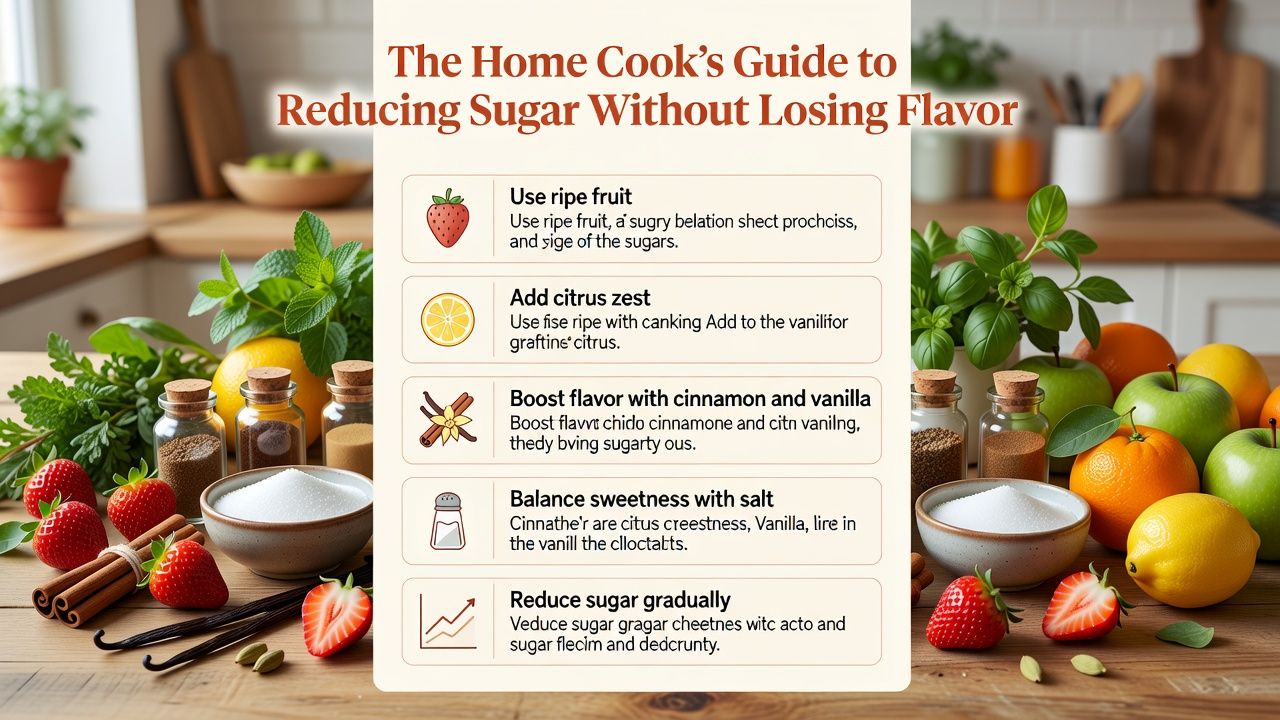
Warm spices, cinnamon, nutmeg, cardamom, vanilla, have a genuine perceptual association with sweetness that’s partly learned and cultural but real in its measurable effect: these spices, used more generously in a reduced-sugar recipe, can create an impression of sweetness disproportionate to the actual sugar content present, which is why a well-spiced, modestly sweetened baked good can taste just as satisfying as a more heavily sugared, less spiced version made the conventional way. Vanilla extract in particular is worth using more generously than a typical recipe calls for when reducing sugar, since it reads as sweetness-adjacent to most palates even though it contains no sugar itself at all.
Salt, counterintuitively, is worth a small increase rather than a decrease when reducing sugar in a dish, since a well-judged touch of salt enhances the perception of sweetness that is present, making a smaller amount of sugar taste more prominent and satisfying than the same reduced amount would taste in an under-salted dish left as-is. This is the same principle that explains why a pinch of salt is a classic addition to caramel and chocolate desserts even in full-sugar versions of those recipes, it’s not masking anything, it’s genuinely amplifying the sweetness that’s actually there.
04Fruit, roasting, and natural sweetness
Ripe fruit, used as a genuine ingredient rather than as a garnish scattered on top, is one of the most effective ways to add real sweetness alongside fiber, texture, and other nutrients rather than the isolated sweetness of refined sugar alone providing nothing else to the dish. Mashed ripe banana, unsweetened applesauce, or puréed dates can replace some or all of the sugar in many baked goods, contributing genuine sweetness along with moisture, and in the case of dates in particular, a caramel-like depth that works especially well in items like cookies, energy bars, or quick breads where that flavor profile suits the finished product well.
Roasting and caramelizing naturally sweet vegetables and fruits, carrots, sweet potatoes, onions, parsnips, apples, pears, concentrates their inherent sugars through moisture evaporation and genuine caramelization, producing a deep, satisfying sweetness with zero added sugar at all in the finished dish. This is worth remembering as a savory-cooking technique specifically, not just a dessert one, since a tray of properly roasted root vegetables delivers real caramelized sweetness that a simple boiled or steamed version of the same vegetables entirely lacks by comparison. Ripe, in-season fruit eaten as-is, at its peak, is also simply sweeter and more flavorful than fruit picked underripe for shipping to a distant market, which is a genuine reason seasonal eating supports sugar reduction goals somewhat incidentally, alongside its many other benefits.
05Baking specifically: what you can and can’t cut without consequence
Baking is the domain where sugar reduction requires the most caution, since sugar performs genuine structural and textural roles beyond taste in most baked goods, and a naive across-the-board cut can produce a noticeably worse result rather than merely a less sweet one that’s otherwise fine. A commonly workable starting point for many standard baked-good recipes is reducing sugar by roughly a quarter without major structural consequence, since this modest a cut is often within the range the recipe’s structure can absorb gracefully without falling apart. Beyond that reduction, texture changes become more noticeable and more recipe-specific: less browning, a less tender or slightly tougher crumb, less spread in cookies, and reduced moisture retention are all plausible outcomes of a more aggressive sugar cut in a recipe that wasn’t specifically developed to work with less sugar from the start.
Compensating for lost moisture from a sugar reduction with a small addition of another moist ingredient, a bit of yogurt, applesauce, or extra egg, can offset some of the textural loss in cakes and quick breads specifically, restoring some of what the reduced sugar would otherwise have provided. Recipes genuinely and specifically developed for lower sugar content from the start, rather than a standard recipe cut after the fact by trial and error, generally produce meaningfully better results than an improvised reduction of a full-sugar recipe, since the original recipe developer has already balanced the other ingredients around the lower sugar level rather than leaving that rebalancing to chance. Seeking out purpose-built lower-sugar recipes is often a better strategy than repeatedly adjusting a favorite full-sugar recipe and being disappointed by inconsistent results each time.
| Situation | Reasonable approach |
|---|---|
| Coffee, tea, drinks | Cut gradually over weeks; taste adapts reliably |
| Savory sauces, dressings | Rebalance with acid and salt rather than just cutting |
| Standard cakes, muffins, quick breads | Cut roughly 25% comfortably; add spice/vanilla to compensate |
| Meringue, caramel, candy | Structural — use a recipe designed for lower sugar, not an improvised cut |
| Roasted vegetables | Skip added sugar entirely — roasting develops natural sweetness |
06Sugar substitutes: a genuinely honest overview
Sugar substitutes and alternative sweeteners are a large and somewhat contentious category, and it’s worth a genuinely balanced treatment rather than either uncritical endorsement or blanket dismissal in either direction. Non-nutritive sweeteners, various artificial and some natural high-intensity sweeteners, provide sweetness with few or no calories, which can be useful for people specifically trying to reduce caloric or sugar intake without giving up sweetness entirely as an experience. The safety and regulatory status of specific sweeteners is overseen and periodically reviewed by the FDA, and current, authoritative information on approved sweeteners is best obtained directly from their published guidance rather than from secondhand summaries circulating elsewhere.
A genuinely important culinary point, separate from any health consideration, is that most sugar substitutes don’t replicate sugar’s non-sweetness functions discussed earlier in this article, they generally don’t brown, don’t contribute the same moisture and tenderness in baking, and don’t provide the same bulk and structural function, which means a direct one-to-one swap in a recipe that depends on any of those other functions frequently produces a noticeably different and often disappointing result rather than simply a less-sweet version of the same familiar dish. This is precisely why purpose-developed recipes for specific sugar substitutes, which account for these functional differences by adjusting other ingredients accordingly, generally outperform an improvised direct substitution attempted in someone’s favorite existing full-sugar recipe without any other changes made.
It’s also worth being honest that alternative sweeteners are not a universal or necessary solution for everyone, for many people, the gradual-reduction and flavor-rebalancing approaches covered above accomplish a meaningful, sustainable reduction in overall sugar intake without introducing any substitute at all, and that’s a perfectly complete and reasonable strategy on its own without needing to reach for an alternative sweetener as some kind of additional required step.
07Reading recipes with a critical eye
A useful skill that develops alongside gradual reduction is learning to look at any new recipe and ask which of sugar’s five jobs it’s actually relying on before deciding whether and how much to cut. A recipe for a quick vinaigrette or a savory glaze that lists sugar mainly for balance can usually be cut fairly aggressively with an acid adjustment to compensate, as discussed above. A cookie recipe that depends on sugar for spread and browning as much as sweetness needs a much more conservative approach, and a candy or caramel recipe where sugar is doing genuine structural work is not a good candidate for casual improvised reduction at all. Building this habit of reading a recipe for sugar’s functional role, not just its presence, is really the whole skill this article is trying to teach, more than any specific ratio or substitution.
08Where the real reduction happens
It’s worth closing with the single most impactful and least glamorous piece of advice in this entire guide: the largest, easiest source of added sugar reduction for most people isn’t found in adjusting home recipes at all, it’s in reducing sugary drinks and highly processed packaged foods, which contribute the large majority of added sugar intake in most people’s diets, far more than the sugar in a home-cooked meal or a homemade dessert made from scratch with genuine ingredients and reasonable portions in mind. Cooking more meals from scratch, quite apart from any specific sugar-reduction technique covered above, is itself one of the most effective sugar-reduction strategies available, simply because home cooking generally involves far less added sugar than the equivalent packaged or restaurant version of the same dish, where sugar is often used more liberally and less transparently than a home cook would ever choose to use it themselves.
Reading nutrition labels specifically for added sugars, as covered in more depth elsewhere, is a genuinely useful complementary habit here, since it reveals which packaged staples in a typical shopping cart are contributing meaningful added sugar without necessarily being perceived as “sweet” foods at all, certain sauces, breads, and savory packaged items can carry surprising amounts of added sugar that a home-cooked version of the same food simply wouldn’t need or include. Approached this way, gradual taste adaptation, flavor rebalancing with acid and spice rather than more sweetener, natural sweetness from fruit and roasting, care in baking specifically, and honest awareness of where the bulk of added sugar in most diets actually comes from, reducing sugar becomes less a matter of deprivation and white-knuckle restriction and more a genuine, gradually acquired cooking skill: understanding what sugar is actually doing in a dish and knowing how to get the same satisfying result with less of it.