Entertaining & Hosting
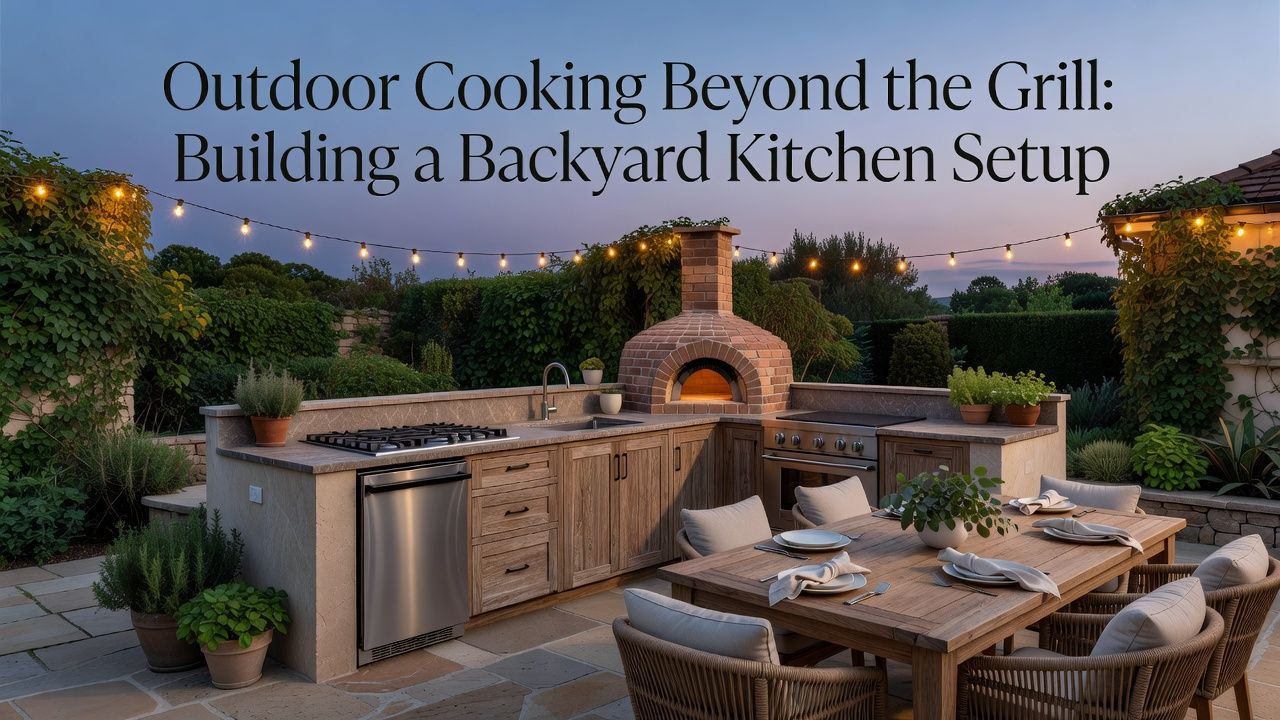
A grill is one outdoor cooking tool among many. Add two or three more, thoughtfully chosen, and a backyard stops being a place you occasionally cook and becomes an actual second kitchen.
For most households, “outdoor cooking” means one thing: a grill, used for the same rotation of burgers, sausages, and chicken through the warmer months of the year. That’s a genuinely good foundation, but it’s also only one tool in a much larger, genuinely useful toolkit, and expanding beyond it opens up an entire range of dishes and techniques that a grill alone can’t easily produce, wood-fired pizza with a genuinely blistered crust, slow-smoked meat with real depth of flavor, precisely controlled outdoor sautéing, or the specific charred, smoky character of a plancha-cooked vegetable that a standard grate simply can’t replicate. This guide looks at how to build a genuinely capable outdoor cooking setup beyond the grill, equipment by equipment, along with the safety fundamentals that matter more outdoors, in less controlled conditions, than they typically do in a kitchen.
None of this requires an elaborate, expensive outdoor kitchen renovation to get real value from the effort; a single well-chosen additional piece of equipment, thoughtfully used, expands what’s cookable outdoors considerably beyond the standard grill rotation. The approach here, as with equipping any kitchen, is to match additions to how you actually cook and entertain rather than acquiring everything that looks appealing in a catalogue, and to take the safety fundamentals seriously precisely because outdoor cooking involves more variables, wind, uneven surfaces, proximity to structures, less consistent supervision as guests move around a larger space, than cooking indoors typically does.
01Beyond the grill: what each additional tool actually adds
A dedicated smoker opens up an entirely different category of cooking from a standard grill: low, slow, indirect heat combined with wood smoke, producing the deep flavor and tender texture associated with proper barbecue, brisket, pulled pork, ribs, that a standard grill, designed primarily around higher, more direct heat, genuinely cannot replicate well regardless of how it’s adjusted or how long the cook is extended. This is a real time commitment, often many hours per cook, and it’s worth being honest that a smoker rewards a specific kind of patient, occasional-project cooking rather than being a quick weeknight tool; it earns its space for a household that genuinely wants to make real barbecue periodically, and it’s a poor purchase for someone hoping for a faster path to smoky flavor on an ordinary weeknight.
A pizza oven, whether wood-fired, gas-fired, or one of the newer compact countertop models designed specifically for outdoor use, reaches temperatures far beyond what a standard home oven or grill can achieve, producing the genuinely blistered, charred, quickly-cooked crust characteristic of proper pizzeria-style pizza in a matter of minutes rather than the far longer, different-textured result a conventional oven produces working at much lower heat. A plancha or flat-top griddle, increasingly popular as an outdoor cooking addition, offers precise, even, consistent heat across its whole flat surface, excellent for smashed burgers, delicate seafood, pancakes, or vegetables that would fall through a standard grill’s grates and be lost to the coals below before they’re properly cooked.
| Equipment | Unlocks | Best for |
|---|---|---|
| Smoker | Low-and-slow, real barbecue flavor | Patient, occasional big-project cooks |
| Pizza oven | Very high heat; genuine blistered crust | Households that entertain around a shared, fast-cooking dish |
| Plancha / flat-top | Even heat for delicate or small-cut food | Seafood, smashed burgers, vegetables, breakfast |
| Outdoor burner / side stove | Real sautéing, sauces, big-batch boiling | Keeping heat and mess out of the indoor kitchen |
| Charcoal or wood grill (alongside gas) | Genuine smoke flavor gas can’t replicate | Anyone who values that specific flavor over gas convenience |
02The outdoor burner: an underrated, genuinely versatile addition
A simple, high-output outdoor propane burner or a dedicated outdoor side-stove setup is genuinely underrated as a backyard cooking addition, mainly because it doesn’t carry the same visual excitement as a smoker or pizza oven when photographed, despite offering real practical value on a much wider range of ordinary evenings. It allows genuine stovetop techniques, sautéing, reducing a sauce, boiling a large pot of pasta or seafood, deep-frying, entirely outdoors, which is particularly valuable for anything that generates significant heat, splatter, or strong odor that you’d rather keep out of an indoor kitchen entirely, especially useful during hot weather when adding more heat to an already warm indoor kitchen is genuinely unwelcome for anyone standing near the stove.
This is also the piece of equipment that makes genuinely large-batch cooking for a crowd considerably more practical than working within a standard indoor kitchen’s burner capacity and pot sizes allow: a large pot of seafood boil, a big batch of paella, or a large-format sauce all become far more manageable with a dedicated high-output outdoor burner than attempting the same volume on a standard indoor stovetop, competing for space and burner capacity with everything else being simultaneously prepared for a large gathering that same evening.
03Fire safety: the fundamentals that genuinely matter
Outdoor cooking involves open flame and high heat in an environment with more variables than a controlled indoor kitchen, wind, uneven ground, structures and vegetation nearby, less consistent supervision as guests move around a larger space over the course of an evening, and taking fire safety seriously here matters genuinely more than it might indoors, not less, despite the more casual, relaxed atmosphere outdoor entertaining often has. Positioning any grill, smoker, or open-flame cooking equipment a genuinely safe distance from the house, any overhanging structures, deck railings, and dry vegetation is the single most important and most commonly overlooked safety fundamental; the National Fire Protection Association and local fire safety authorities publish specific distance recommendations worth following rather than estimating casually on the day, and it’s worth checking these guidelines directly for the specific equipment you’re using rather than assuming any distance feels intuitively sufficient based on a rough guess.
Keeping a fire extinguisher rated for the relevant type of fire, or at minimum having a way to smother flames, a metal lid, sand, baking soda for a small grease fire specifically, and a reliable water source genuinely accessible and known to whoever’s cooking, is basic, non-negotiable preparation rather than excessive caution, and it’s worth confirming this setup before, not during, an actual emergency when there’s no time to search for it. Never leave any open flame or lit cooking equipment unattended, particularly with children or pets moving through the same space unsupervised, and be especially mindful of wind direction and wind strength, which can carry sparks, embers, or flame in an unpredictable direction considerably faster and further than most people initially expect when they’re focused on the food rather than the surrounding conditions.
Before you light anything
Check clearance distance from structures and vegetation for your specific equipment. Confirm a fire extinguisher or smothering method and water source are genuinely within reach, not just somewhere in the house. Check the wind. These three checks take under a minute and matter every single time, not just for the first use of new equipment.
04Propane and charcoal: fuel-specific safety habits
Propane equipment carries its own specific set of safety habits worth genuinely internalizing rather than skipping out of familiarity built up over years of casual use without incident. Check gas connections and hoses periodically for leaks, a simple soapy water solution brushed onto connections will visibly bubble if gas is escaping, a genuinely reliable and low-cost check worth doing at the start of each outdoor cooking season and periodically through it rather than just once when the equipment was new. Never check for a gas leak with an open flame, and always open the lid of a gas grill before igniting it, since gas that’s accumulated inside a closed grill can ignite with real force and intensity once a flame source is introduced into that enclosed space. Store propane tanks upright, outdoors, away from any direct heat source, and never store a spare tank indoors or in an attached, enclosed structure like a garage where a leak could accumulate unnoticed.
Charcoal and wood-fired equipment carry a different, equally important set of concerns, centered mainly on carbon monoxide and ember management rather than gas leaks. Never use charcoal, a smoker, or any similar combustion equipment in an enclosed or poorly ventilated space, including a garage with the door partially open, an enclosed porch, or a tent, since carbon monoxide from incomplete combustion builds up quickly in enclosed spaces and is a genuine, serious, sometimes fatal hazard that has no smell to warn you it’s accumulating. This equipment is designed exclusively for open, well-ventilated outdoor use and should never be treated as adaptable to enclosed spaces regardless of weather or convenience on a rainy evening. Dispose of ash and coals only once they’re completely, thoroughly cool, ash that appears cool on the surface can retain genuine, dangerous heat for many hours underneath the top layer, and disposing of it too early, particularly into anything combustible like a regular trash bag or bin, is a genuine and surprisingly common fire risk that catches people off guard.
05Food safety outdoors: the part that’s easy to forget in a relaxed setting
Outdoor entertaining tends to involve a more casual, relaxed atmosphere than indoor cooking, and food safety fundamentals are correspondingly easy to let slip in that relaxed setting, even though the actual risks, hot weather, food sitting out longer than intended, less consistent temperature control than an indoor kitchen provides, are often genuinely higher outdoors than in a controlled indoor environment. The general food-safety principle worth remembering specifically for outdoor and hot-weather entertaining is that perishable food shouldn’t sit out at room temperature, and particularly not in direct sun or genuinely hot weather, for more than a fairly limited window of time. Current specific guidance on safe holding times and temperatures is published by FoodSafety.gov and the USDA Food Safety and Inspection Service, and it’s genuinely worth reviewing before a summer outdoor gathering specifically, since the window shrinks meaningfully in hot weather compared to a cooler indoor room where the same food might sit safely for longer.
Using a meat thermometer to confirm safe internal temperatures, rather than judging doneness purely by appearance or time elapsed, matters just as much outdoors as it does indoors, and arguably more, given how much more variable outdoor cooking conditions, wind, temperature swings, inconsistent heat sources like coals that are dying down partway through a cook, can be compared to a controlled indoor oven or stovetop with a reliable dial. Keeping raw and cooked food genuinely separate, separate platters and utensils for raw meat going onto the grill versus cooked meat coming off it, in particular, is a simple, well-known principle that’s nonetheless commonly and easily forgotten in the more casual, relaxed flow of an outdoor gathering with multiple things happening simultaneously and several people involved in the cooking and serving at once. And keeping cold food genuinely cold, on ice, in a cooler, replenished as needed through a long outdoor event, matters more in hot weather specifically than the same food would require indoors in a climate-controlled room.
06Weatherproofing and off-season storage
A practical concern that doesn’t get as much attention as the cooking itself is protecting outdoor equipment from the elements between uses, since a grill, smoker, or pizza oven left uncovered through a wet or freezing season deteriorates far faster than the same equipment properly protected, and replacing rusted-out equipment prematurely is a genuinely avoidable expense. A well-fitted cover, used consistently rather than only when it happens to be convenient, extends the working life of any outdoor cooking equipment substantially, and it’s a small, cheap habit relative to the cost of the equipment it protects.
For anyone in a climate with a genuine off-season, cleaning equipment thoroughly before storage, disconnecting and properly storing propane tanks as discussed above, and checking for any pest activity that might have taken up residence over winter before the next season’s first use are all worth building into an annual routine rather than discovering a problem mid-cook the first warm weekend of spring when everyone’s eager to get started again.
08Lighting the cooking area for evening use
A genuinely practical addition that often gets overlooked entirely in the excitement of choosing bigger equipment is proper lighting for whoever’s actually doing the cooking once the sun goes down, which happens earlier than expected on plenty of warm-weather evenings that start with plenty of daylight and end well after dark. A dedicated task light aimed at the grill, burner, or prep surface, rather than relying on whatever ambient light happens to be available from the house or a distant patio fixture, makes a genuine difference to both safety and food quality, since judging doneness, checking for flare-ups, and handling hot equipment all become meaningfully harder in poor light regardless of how experienced the cook happens to be.
A simple clip-on or mounted light rated for outdoor use, positioned to illuminate the cooking surface directly rather than the general surrounding area, is a small and inexpensive addition that pays for itself the first evening a gathering runs later than planned and the cook is still working the grill well after sunset. This is worth planning for at the same time as the rest of the setup, rather than discovering the gap only once it’s already dark and the food still needs another twenty minutes.
09Building the setup that suits how you actually entertain
As with any equipment decision, the honest question to ask before adding anything beyond a basic grill is how you actually entertain, not how you imagine an ideal version of yourself entertaining on a warm summer evening. A household that hosts large, frequent summer gatherings genuinely benefits from a more complete setup, perhaps a grill, an outdoor burner for big-batch dishes, and a pizza oven as a genuine social centerpiece guests gather around and participate in themselves. A household that grills occasionally for a small group has less to gain from a serious equipment investment and might get more genuine, proportionate value from one well-chosen addition, an outdoor burner, most likely, given its broad and genuinely everyday versatility, rather than a full outdoor kitchen buildout that would see only occasional real use across a typical year.
Climate and available space obviously and significantly affect what’s genuinely worth investing in as well: a household in a climate with a long, warm outdoor season gets proportionally more real use, and correspondingly better value, out of a more complete outdoor cooking setup than one in a climate where outdoor cooking is realistically viable for only a few months of the year. Available space matters just as much as climate; a compact patio might comfortably fit a grill and a small outdoor burner but genuinely can’t accommodate a full pizza oven and smoker as well, and being realistic about physical space, alongside genuinely honest self-assessment about your actual entertaining habits and frequency, prevents the same kind of underused-appliance regret that applies to indoor kitchen equipment applying equally, if not more so, to larger and more expensive outdoor purchases that are harder to quietly return.
Whatever specific equipment ends up in a backyard setup, the fundamentals covered here, clearance and fire safety from the very first use, fuel-specific handling for whichever fuel source you’re actually using, real food-safety discipline maintained even in a relaxed outdoor atmosphere, seasonal protection for the equipment itself, and equipment additions chosen deliberately to match genuine, honest entertaining habits rather than aspirational ones, matter more than any specific brand or model recommendation ever could. Get those fundamentals right, and a backyard genuinely becomes a second, fully capable kitchen rather than merely a place where a grill occasionally gets used through the warmer months of the year.