Entertaining & Hosting
A table set with three ordinary decisions made deliberately looks more considered than one covered in a dozen decorative objects with no unifying idea behind them.
There’s a specific quality certain tables have that’s difficult to name precisely but instantly recognizable the moment you sit down at one: a sense that every element was placed deliberately, that the whole arrangement adds up to something coherent, even when the individual pieces are perfectly ordinary and inexpensive on their own. And there’s an opposite quality, equally recognizable, where a table covered in decorative objects, candles, flowers, place cards, favors, elaborate folded napkins, still somehow reads as cluttered and unconsidered rather than special despite the obvious effort involved. The difference between these two outcomes has almost nothing to do with budget or the sheer number of items involved, and almost everything to do with a small number of underlying principles: coherence, appropriate scale, and restraint applied consistently throughout.
This guide covers exactly those principles, not a rigid formal etiquette manual dictating precise fork placement to the millimeter, but a practical framework for making a table feel genuinely intentional using ordinary, accessible materials most people already own. Formal etiquette has its place for specific, genuinely formal occasions, and where it’s relevant it’s worth knowing, but the far more common and far more useful skill for most home entertaining is understanding why certain simple choices consistently read as considered while others, sometimes involving more effort and more objects, read as merely busy and overdone.
01The basic setting: what actually needs to be there
A functional, correctly arranged place setting is the genuine foundation everything else builds on, and getting these basics right matters more to the overall impression than any decorative addition placed on top of a poorly arranged setting underneath it. The standard logic, worth knowing even in its simplified everyday form, is that utensils are arranged in the order they’ll be used, working inward from the outside toward the plate as the meal progresses course by course: forks generally to the left of the plate, knives and spoons to the right, with the blade of the knife facing inward toward the plate rather than outward. Glasses sit above and to the right of the plate, generally arranged in the order they’ll be used through the meal, water glass typically first and closest, with wine glasses arranged accordingly if multiple wines are being served across different courses of the meal.
The napkin’s placement is flexible and varies by occasion and tradition, to the left of the forks, on the plate itself, or in a glass, are all reasonable and commonly seen choices, and none is objectively more correct than another for casual or semi-formal home entertaining specifically. More genuinely important than the exact placement convention chosen is picking one and applying it consistently across the whole table, since inconsistency between place settings reads as careless in a way that any single reasonable placement choice, applied uniformly to every seat, does not. For a genuinely casual meal, a much-simplified version of this, a fork, a knife, a napkin, one glass, is entirely appropriate and doesn’t need to be dressed up with extra courses or utensils that won’t actually be used during the meal, since unused silverware just adds visual clutter without any real function.
| Element | Standard placement |
|---|---|
| Forks | Left of the plate, outermost used first |
| Knife | Right of the plate, blade facing inward |
| Spoon | Right of the knife |
| Glasses | Above the knife, roughly in order of use |
| Napkin | Left of forks, on the plate, or in a glass — any is fine if consistent |
02Coherence: the single principle that matters most
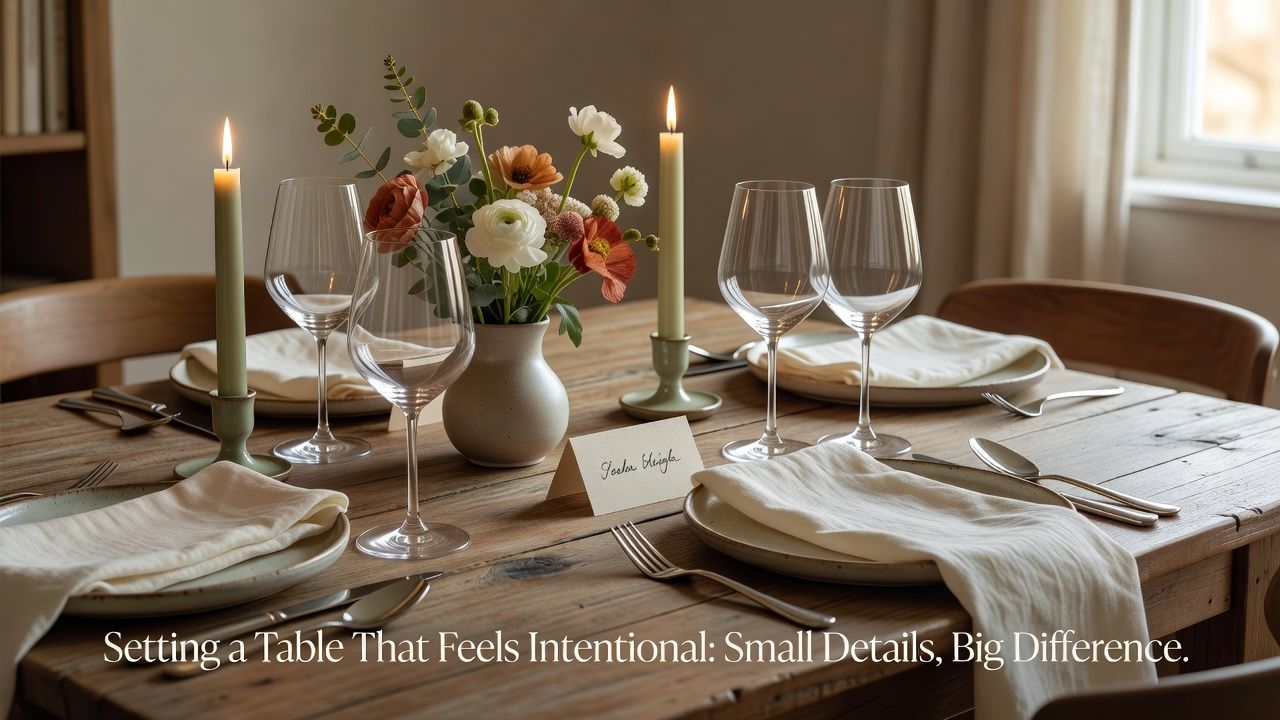
If there’s one idea worth taking away from this entire article, it’s coherence: a table where every element relates to a single, simple, unifying idea, a color palette, a season, an occasion, a mood, reads as considered and intentional in a way that a table with more individually beautiful but disconnected elements simply doesn’t, no matter how much each piece cost on its own. This is, in a real sense, the same principle behind good outfit-building or good interior design applied specifically to a table: a small number of elements that clearly belong together beats a larger number of elements that don’t share any obvious relationship, even when each individual piece is genuinely lovely in isolation, viewed on its own.
The practical way to apply this is choosing one anchor, a color palette drawn from the season, the specific occasion, or simply what you already own and love, and letting every other decision on the table serve that anchor rather than introducing new, competing ideas that pull the eye in different directions. If the anchor is a deep autumn palette, that might mean warm-toned linens, a scattering of small gourds or seasonal foliage, and candles in a complementary warm tone; every choice reinforces the same idea rather than each element making its own separate, disconnected visual statement that competes for attention. This single habit, more than any specific purchase or decorative object, is what separates a table that feels genuinely put-together from one that feels like several different, perfectly nice ideas thrown together without an organizing thread connecting them into a whole.
Pick one anchor, then edit toward it
Before adding anything to a table, decide on one simple unifying idea — a color, a season, a mood. Then, for every object you’re considering adding, ask whether it genuinely serves that idea or is just something else nice you happen to own. When in doubt, leave it off. A table with fewer, coherent elements consistently outperforms one with more, disconnected ones.
03Height, scale, and the centerpiece problem
A common and entirely avoidable mistake is a centerpiece so tall or so wide that it genuinely blocks sightlines and conversation across the table, a beautiful floral arrangement is a real liability if guests seated across from each other have to lean sideways or crane their necks just to see one another and actually talk, which rather defeats the whole social purpose of a shared meal in the first place. The practical guideline: centerpieces should either sit genuinely low, well below eye level when guests are seated, or be tall and narrow enough that sightlines pass comfortably beneath or around them without obstruction, the dangerous middle height, roughly at seated eye level, is what actually blocks conversation and is worth avoiding regardless of how attractive the individual arrangement might look on its own before anyone actually sits down at the table.
Varying heights slightly across the table, a few different candle heights, for instance, rather than a uniform row of identical ones, generally creates visual interest without the flatness of everything sitting at exactly one level throughout the whole arrangement. This is a small, low-cost adjustment that adds real visual dimension without adding any new elements or any real cost or effort beyond a slightly more thoughtful arrangement of what you already have. And it’s worth being genuinely mindful of scale relative to the table’s actual size and the number of place settings involved: an appropriately generous centerpiece for a table set for ten looks sparse and underwhelming reduced by half for a table set for four, and conversely, a centerpiece proportioned for four people can feel oddly cramped and out of balance stretched across a table meant for ten, so scale the centerpiece to the table you’re actually setting, not to what happened to be available or on sale at the shop.
04Lighting: the cheapest, highest-impact addition available
Candlelight has an outsized effect on how a table feels relative to its actual cost, and it’s genuinely one of the most efficient investments available for making an ordinary meal feel like a considered occasion without spending much at all. The warm, flickering, low quality of candlelight is flattering to both food and faces in a way that overhead artificial light generally is not, and simply dimming or turning off harsh overhead lighting in favor of candles for a dinner meaningfully changes the entire atmosphere of a room without a single other change to the table itself needing to happen.
Varying candle heights, as mentioned above, adds visual interest at essentially no additional cost beyond what a uniform set of matching candles would have cost anyway, and unscented candles are generally the better choice at a dinner table specifically, since strongly scented candles can genuinely compete with and distort the aroma of the food being served, which is a real if often overlooked consideration when choosing what to buy. For anyone with a genuine safety concern around open flame, households with young children, pets prone to knocking things over, or simply a personal preference for avoiding fire indoors, battery-powered LED candles have become convincing enough in recent years to be a completely legitimate substitute that preserves most of the same warm visual effect without the fire risk attached to it.
05Mixing formal and casual elements deliberately
One of the more effective, genuinely modern approaches to table setting is the deliberate, considered mixing of formal and casual elements, rather than a table that reads as either entirely formal or entirely casual throughout its whole arrangement, good linen napkins alongside simple everyday plates, for instance, or fine glassware paired with a rustic wooden table and simple ceramic dishes. This kind of deliberate mixing, done thoughtfully, tends to feel more contemporary, more personal, and genuinely more interesting than either a uniformly formal table, which can feel stiff and impersonal in a home setting among friends, or a uniformly casual one, which can feel like no particular thought went into it at all before guests arrived.
The key to making this kind of deliberate mixing work, rather than simply looking like mismatched leftovers from different sets pulled together at the last minute, circles back to the coherence principle discussed above: the mixing should feel like a genuine, deliberate choice connected by that same unifying color palette or mood, not like a random assortment of whatever happened to be in the cupboard on a given evening with no thought behind it. A specific, common and reliable example: using cloth napkins even for an otherwise entirely casual meal is one of the single most effective ways to elevate an ordinary weeknight-style dinner into something that feels genuinely more special, at essentially no cost beyond the modest extra laundry involved, and it’s a small detail disproportionate in its actual effect relative to its cost or effort required.
06Using what you already own well
None of the principles covered so far require purchasing anything new, and it’s genuinely worth emphasizing this point directly, since table setting is an area where it’s easy to feel that a special occasion demands special new purchases before anyone sits down. Mismatched dishware, used deliberately and intentionally rather than apologetically as though it’s a shortcoming, can look genuinely charming and collected rather than accidental, particularly when the pieces share some connecting thread, a similar color family, a similar general era or style, that ties them together into a coherent whole rather than a genuinely random assortment thrown together without thought. This connects directly back to the coherence principle, since even deliberately mismatched items need some unifying logic to read as a considered choice rather than an unconsidered accident that just happened.
Foraged or garden-cut natural elements, a few branches, some seasonal greenery, herbs from a garden or even a windowsill pot, fruit arranged simply in a bowl, can make for a genuinely beautiful and completely free centerpiece, often more interesting and more personal than anything purchased from a shop, and they connect naturally and effortlessly to whatever season the meal happens to be taking place in without any extra effort required. Repurposing everyday objects for a special-occasion role, jars as simple vases, a cutting board as a rustic cheese or bread board, a favorite bowl doing double duty as a serving piece, is both economical and, done thoughtfully within that same coherent-idea framework discussed throughout, can read as more genuinely creative and personal than an equivalent purchased, purpose-made item ever would on its own.
07Setting the table for children and mixed-age groups
A practical note worth including for anyone hosting a genuinely mixed-age gathering: the same coherence principle applies even when the table needs to accommodate children alongside adults, and it’s worth resisting the instinct to abandon any design intention entirely just because sturdier, more casual dishware is needed at some seats. Choosing children’s plates or cups in a color that fits the same palette as the rest of the table, rather than whatever bright plastic happens to be in the cupboard, keeps the overall coherence intact even where practicality demands a different material at a few specific seats. This small adjustment means a family table can still read as considered and pulled-together, rather than looking like two entirely separate tables were accidentally combined into one.
09Adjusting the same principles outdoors
Everything above translates directly to an outdoor table, with a couple of practical adjustments worth planning for in advance rather than discovering mid-meal. Wind is the main new variable: tall candles and loose, light table linens can become genuinely impractical outdoors, and it’s worth choosing shorter, more wind-resistant candles or lanterns, and weighting down any linens with something unobtrusive, rather than fighting a losing battle against a breeze all evening while guests are trying to eat. The coherence principle still applies just as strongly, an outdoor table anchored around a natural, garden-inspired palette often feels more genuinely intentional than one that imports a strictly indoor aesthetic wholesale into a setting where it doesn’t quite belong.
Practical concerns particular to eating outside, insects, fading light as the evening goes on, surfaces that aren’t perfectly level, are worth planning for without letting them dominate the whole design. A citronella candle or two, chosen in a similar tone to the rest of the lighting rather than a jarringly different bright yellow, can serve double duty as both function and part of the coherent visual plan discussed throughout this guide, rather than sitting apart from it as an obviously utilitarian afterthought.
10Knowing when to stop
The final principle, and in many ways the most important corrective to everything discussed above, is restraint: the instinct to keep adding elements, another candle, another decorative object, place cards, favors, an elaborate napkin fold, well past the point where they’re genuinely contributing to the table’s coherence is one of the most common ways a genuinely promising table setting ends up feeling cluttered and overdone rather than special by the time guests actually sit down. A genuinely useful practical habit is to set the table, then deliberately step back and remove roughly one in five items before finalizing it, almost every table benefits from slightly less rather than slightly more, and this small, deliberate editing pass consistently improves the result more than any additional object ever would.
Function should never be sacrificed for decoration in any of this: guests genuinely need enough room to actually eat comfortably, decorative elements shouldn’t ever obstruct food, drink, or conversation across the table, and a beautiful table that’s genuinely uncomfortable or impractical to actually eat at has failed at its actual, primary purpose regardless of how photogenic it might look before anyone sits down and starts using it. The single, most reliable test worth applying to any addition under consideration: does this specific element serve the coherent idea you’ve chosen for the table, and does it make the meal genuinely more pleasant and comfortable to actually sit through, or is it there mainly because it exists and seemed like it should be included somewhere on the table. A table built consistently around that question, a clear unifying idea, appropriate scale, good lighting, genuine coherence between elements, and a real willingness to stop adding once the point has been made, will reliably feel more intentional than one assembled by simply accumulating everything nice that happened to be available, however individually lovely each of those things might be on its own.