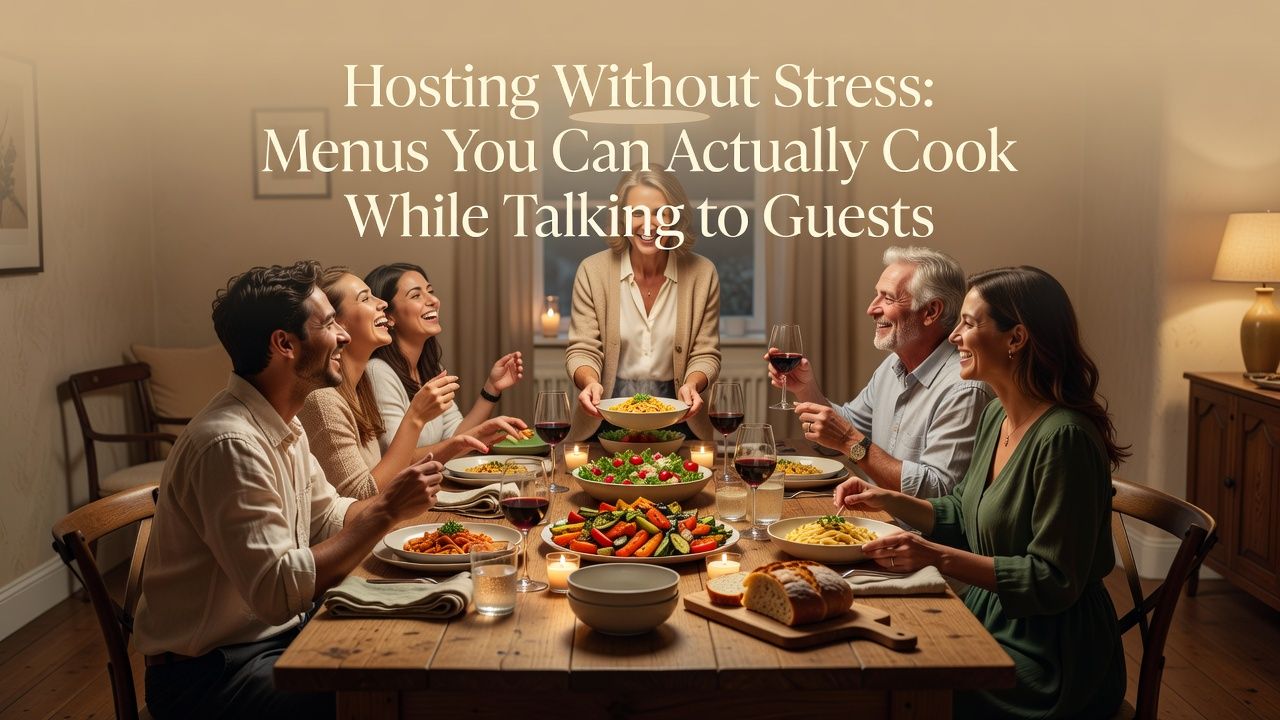
Hosting Without Stress: Menus You Can Actually Cook While Talking to Guests
Entertaining & Hosting
The best dinner party hosts aren’t better cooks than everyone else. They’re better menu planners — and the menu is where the stress actually gets designed in or out.
The universal image of hosting stress is a host trapped in the kitchen, sweating over a stove, missing the entire evening they invited people to in the first place. Almost every time this happens, the actual problem isn’t a lack of skill, it’s a menu that requires active, attentive, last-minute cooking for most of its components, so that the host is structurally unable to be anywhere but the stove when guests arrive and the evening actually begins. This is entirely avoidable, and the fix has nothing to do with becoming a faster or more skilled cook under pressure. It has to do with choosing dishes, in advance, specifically for their compatibility with being made ahead, left alone, or finished with minimal last-minute attention once the guests are already through the door.
This is a genuinely learnable skill, separate from cooking skill itself: menu engineering for hosting, where the explicit goal isn’t necessarily the most impressive possible dishes on paper, but a combination of dishes whose collective timeline lets the host actually be present at their own party from start to finish. A host who serves a slightly simpler menu and spends the evening at the table with their guests has thrown a genuinely better party than one who serves something more elaborate from behind a closed kitchen door, missing the conversation and the actual point of having invited people over. This guide covers exactly how to build that kind of menu, timeline it properly across the days leading up to the event, and handle the handful of predictable things that go wrong even with the best planning.
01The one active-cooking-time rule
The single most useful principle for a low-stress menu is limiting the number of dishes that require active attention at serving time to exactly one, or at most two if they can genuinely be handled in parallel without conflicting for the host’s attention at the same critical moment. Everything else on the menu should be either fully made ahead and simply reheated or served cold or at room temperature, or so hands-off in its final cooking, a tray in the oven that needs checking once, not stirring continuously for twenty minutes, that it doesn’t meaningfully compete for the host’s attention with actually talking to guests who are standing right there in the kitchen.
This single rule, applied honestly during menu planning rather than optimistically hoped for on the day, eliminates most hosting stress before the evening even starts, because it forces a deliberate choice at the planning stage rather than an improvised scramble on the night itself when it’s far too late to change course. A menu with a make-ahead braise, a room-temperature salad or side dressed and ready to go, and bread that just needs warming, leaves exactly one thing, perhaps a quick pan sauce, or nothing at all, requiring the host’s active attention once guests have arrived, and that’s a genuinely manageable amount of divided attention compared to juggling four dishes each needing separate, simultaneous, last-minute cooking at the exact moment people are walking through the door.
| Course | Low-stress approach | Avoid |
|---|---|---|
| Starter | Fully cold or room-temp; assembled ahead | Anything requiring a la minute cooking per plate |
| Main protein | Braise, roast, or slow-cooked dish made ahead | Individually seared or pan-fried portions for a crowd |
| Sides | Room-temp salad; a tray that goes in and is left alone | Multiple things needing stovetop attention at once |
| Dessert | Made entirely the day before | Anything assembled or baked after guests arrive |
02Dishes that genuinely reward advance preparation
Certain categories of dish aren’t merely tolerant of being made ahead, they’re genuinely improved by it, which makes the low-stress choice also the objectively better culinary choice, not a compromise between convenience and quality that trades one for the other. Braises, stews, and anything similarly slow-cooked almost universally taste better the next day, once the flavors have had time to meld and settle overnight in the refrigerator undisturbed. This is one of the most reassuring facts in all of hosting, since it means the dish that requires the most cooking time is also the one you can most comfortably finish a full day ahead of the event, with genuinely no quality sacrifice and often a genuine improvement in the finished flavor.
Most desserts, particularly anything involving chilling, setting, or a resting period, cakes, tarts, custards, ice creams, many cookies, are naturally suited to being made a day or more ahead, and attempting to bake a dessert the day of a dinner party, competing for oven space and attention with the main course at the exact moment both need it, is one of the most avoidable sources of hosting stress there is. Marinades, dry rubs, and any advance-flavored components for a main protein can be prepared well ahead of time, meaning the cooking itself on the day is reduced to execution rather than including all of the planning and prep work as well, all compressed into the same tight window.
The better-the-next-day list
Braises, stews, curries, chilis, most soups, and many marinated dishes genuinely taste better a day after cooking. Building a hosting menu around this category isn’t settling for convenience — it’s choosing dishes that are objectively at their best precisely when you need them to be ready, which is a rare and worth-exploiting overlap between “easy” and “excellent.”
03A realistic three-day timeline
Spreading preparation across the days before an event, rather than attempting everything on the day itself in one long, exhausting stretch, is the single biggest structural change that separates a relaxed host from a frantic one, and it doesn’t require starting a week in advance. A genuinely realistic three-day window covers most of what’s needed for a well-organized dinner party without demanding an unreasonable amount of advance planning from a busy person. Two days before, handle the tasks with the longest shelf life and lowest urgency: grocery shopping for anything shelf-stable, cleaning the house, setting the table if space allows it to sit undisturbed that long, and confirming final guest numbers and any dietary requirements that need to be accommodated in the menu.
The day before is where the heaviest cooking should genuinely happen: braises and stews cooked fully and refrigerated overnight, desserts made completely and ready to serve, any sauces or dressings prepared and stored, vegetables washed and prepped, though not necessarily cooked, if they’re better fresh, and fresh grocery shopping for anything that couldn’t be bought two days out without losing quality. This is deliberately the day carrying the most cooking workload, precisely because it’s not the day guests are arriving, which removes the time pressure and social-performance pressure that turns cooking into stress on the day itself, when there’s an audience present.
The day of the event should be reserved for the minimum: reheating what’s already cooked, any genuinely last-minute elements, a salad tossed just before serving, bread warmed, a garnish added at the end, setting out anything that needed to stay refrigerated until close to serving, and, genuinely important, leaving real time to get yourself ready and unwind before guests arrive, rather than still being in an apron with flour on your hands when the doorbell rings unexpectedly early. A host who’s visibly frazzled at the door sets a different tone for the whole evening than one who’s had twenty minutes to actually relax and shift into host mode first.
| Timing | Tasks |
|---|---|
| Two days before | Shelf-stable shopping, house cleaning, table setting, guest confirmation |
| Day before | Main cooking: braise/stew, dessert, sauces, prep; fresh shopping |
| Day of | Reheat, final assembly only, and real time to get ready yourself |
04Serving styles that reduce plating pressure
The choice between plated individual servings and large-format, shared serving dishes has a real effect on hosting stress that’s genuinely separate from the cooking itself and worth considering on its own merits. Family-style serving, large dishes placed on the table for guests to serve themselves, removes the last-minute plating step entirely, since there’s no need to compose individual plates precisely and simultaneously for everyone at the exact moment of serving; guests help themselves at their own pace, which also naturally encourages a more relaxed, conversational atmosphere than the more formal choreography of individually plated courses arriving one after another.
A buffet-style setup extends this same principle further, particularly useful for larger groups, letting guests move at their own pace and effectively eliminating the pressure of getting everyone served and seated at precisely the same moment before food goes cold. Both approaches also tend to reduce the number of trips a host makes between kitchen and table, which is itself a meaningful source of accumulated stress and lost conversation time across a long dinner party, even if each individual trip seems minor when considered in isolation. For most casual and semi-formal hosting situations, family-style or buffet service is both less stressful for the host and, for many guests, a more comfortable and sociable way to eat than a fully plated, restaurant-style service that can feel unexpectedly formal and stiff in a home setting among friends.
05Handling dietary restrictions without a separate menu
Dietary restrictions among guests are increasingly common and worth planning for calmly rather than as a last-minute scramble discovered only once people have already arrived, and the good news is that a well-designed menu can often accommodate several restrictions simultaneously without requiring an entirely separate dish cooked for each individual guest. Ask about dietary restrictions and genuine preferences when you invite people, not the day before the event, giving yourself real planning time rather than a last-minute pivot under pressure. Building a menu with naturally flexible components, a base grain or vegetable dish that’s naturally vegetarian or gluten-free, with a protein served separately and added by each guest as they wish, accommodates several different needs at once without requiring a genuinely separate parallel menu for each individual restriction represented at the table.
Having at least one dish that’s safely and clearly suitable for the most common restrictions among your specific guest list ensures nobody is left with nothing to eat, even if the rest of the menu isn’t universally accommodating to every possible need. This is a considerably lower bar than trying to make every single dish suit every restriction simultaneously, and it’s genuinely achievable with a little planning done in advance rather than improvised on the spot. For anyone with a serious food allergy specifically, being straightforwardly honest with the guest about ingredients and preparation methods, including any risk of cross-contact with allergens in your kitchen, is more important than any amount of thoughtful menu planning, since allergy safety is a genuine health matter that deserves direct, careful communication rather than assumption or guesswork on either side.
06What to do when something goes wrong
Something will go slightly wrong at some hosting occasion eventually, this is close to a certainty over enough dinners hosted across enough years, and planning for it calmly in advance is more useful than simply hoping it never happens to you. Having one genuinely reliable backup element always on hand, good bread, a jar of excellent olives, a wedge of good cheese, that requires zero cooking and can extend or supplement a menu that’s running short or delayed is a simple insurance policy worth keeping stocked for exactly this purpose, just in case. If a dish genuinely fails, the calm, confident response of simply acknowledging it lightly and moving on, rather than visibly panicking or over-apologizing repeatedly through the rest of the evening, generally puts guests at far greater ease than the host’s distress ever does; guests overwhelmingly care more about the host’s mood and the overall atmosphere of the evening than about any single dish being slightly imperfect on the night.
Building a genuine time buffer into the schedule, planning for guests to arrive somewhat before the meal is meant to start, with a first course of pre-set snacks or drinks that require zero attention from the host, absorbs the delays that reliably happen, a dish taking longer than expected, a guest arriving late, without derailing the evening’s actual timeline downstream. This buffer period, often overlooked entirely in planning, is one of the most valuable and least effortful additions to a hosting timeline: a bowl of nuts or olives and a drink on the counter gives guests something to do and a reason not to hover expectantly while the host finishes the last few things, converting what would otherwise be dead, anxious time into a relaxed beginning to the evening for everyone involved.
07Enlisting help without losing control of the kitchen
A host doesn’t have to do everything alone, and delegating specific, well-defined tasks to guests who offer to help, rather than either refusing all offers out of a sense of obligation or handing over vague, undefined responsibility, genuinely reduces the load without creating the kind of kitchen chaos that comes from too many people working without clear roles. Assigning something concrete and self-contained, pouring drinks, finishing a salad with a dressing that’s already made, setting out the dessert, lets a willing guest genuinely contribute without needing to understand the full menu timeline or getting in the way of whatever the host is actively managing at that moment.
08A sample low-stress menu, built with the whole framework
Bringing every principle above together into one concrete example: a starter of good bread, olives, and a simple room-temperature dip, set out before guests are even properly seated, requiring nothing beyond opening a few containers and putting them on the table. A main course built around a braise or stew made entirely the day before and simply reheated gently, served alongside a room-temperature grain or vegetable salad, dressed in advance and left to sit, many benefit from sitting, in fact, since the dressing has time to properly penetrate every part of the dish. A loaf of good, warmed bread on the side, requiring only a brief warm-through in the oven while other things are happening. A dessert made completely the day before, requiring no attention at all on the day beyond bringing it to the table when the moment arrives.
Under this plan, active cooking on the day of the event amounts to roughly gently reheating the braise and warming the bread, perhaps fifteen minutes of genuinely active attention across an entire evening, most of it easily interruptible for conversation with guests standing right there in the kitchen with a drink in hand. Every component was chosen deliberately, at the planning stage, specifically for its compatibility with being made ahead or requiring minimal last-minute attention, rather than for maximum impressiveness in isolation on any single plate. The resulting evening is one where the host is actually present at their own party, which is, in the end, the entire point of hosting in the first place, and it’s the outcome the whole framework in this guide is really designed to produce.