Kitchen Appliances & Gear
Counter space is finite and every appliance is renting it. Here’s the honest frequency test for deciding what earns a permanent spot.
Small appliances are sold on aspiration — the version of yourself who makes fresh pasta weekly, presses juice every morning, bakes bread from scratch every weekend. Most of these purchases are made in good faith and used twice before settling into permanent counter or cupboard residence, quietly gathering dust while continuing to occupy space that could otherwise be doing real daily work. The honest question a small-appliance purchase deserves isn’t “would this be useful” — almost anything is occasionally useful in some hypothetical scenario — but “how often will I actually use this, realistically, based on my actual habits rather than my aspirational ones.” That single reframing eliminates most bad kitchen-appliance purchases before they happen, and it’s a genuinely more useful filter than any spec sheet or review score.
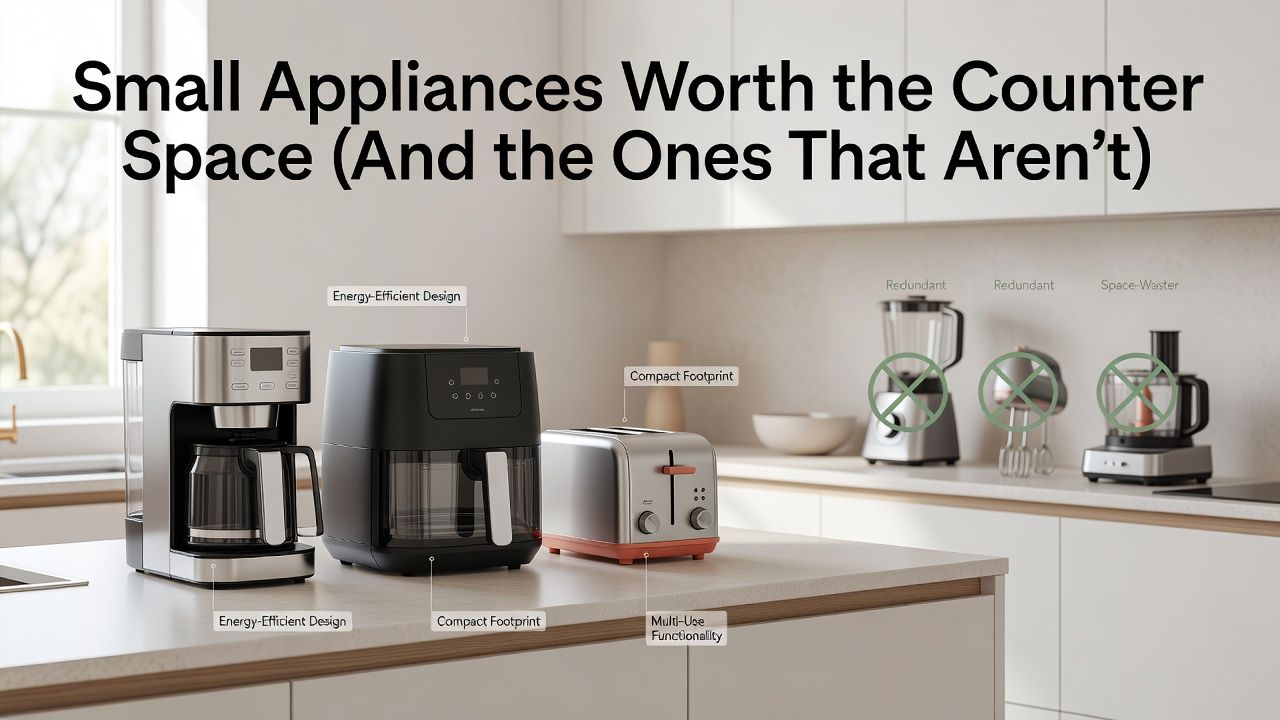
This guide sorts small appliances into three groups: the ones that earn their space in almost any kitchen because they’re used constantly and hard to replicate manually, the ones that are genuinely excellent but only for specific, identifiable cooking habits, and the ones that are frequently bought and rarely used because a basic tool already does the job about as well. None of this is about frugality for its own sake — a stand mixer used weekly is one of the best purchases a serious baker can make, full stop, no caveats needed. It’s about buying for the cook you actually are, not the one you imagine becoming once the appliance is sitting on the counter.
01Nearly universal: earns its space in most kitchens
A few appliances clear the bar for almost any household because the task they do is common, they do it distinctly better or faster than a manual alternative, and their footprint is modest relative to the value delivered. A blender is the clearest case for anyone who makes smoothies, soups, or sauces with any regularity — there’s no manual substitute that comes close, and a mid-range model with real motor power handles the large majority of home blending tasks well, from crushing ice to puréeing a hot soup smooth. An electric kettle, in any household that drinks tea, instant coffee, or simply boils water often, is faster and more energy-efficient than a stovetop kettle or a pot, takes up minimal space, and is one of the cheapest genuine time-savers in the whole kitchen, often boiling a full kettle’s worth of water in a fraction of the time a stovetop equivalent would take.
A good burr coffee grinder belongs here for any coffee drinker, since — as covered in more depth in a companion piece on brewing setups — it improves coffee quality more reliably than almost any other single purchase, coffee machine included, and it’s genuinely one of the highest-value-per-dollar additions to any kitchen that regularly makes coffee at home. And a slow cooker or multi-cooker earns a place in households that regularly want hands-off, low-effort cooking — braises and stews that need long unattended time genuinely benefit from a dedicated vessel, particularly for anyone out of the house all day who wants dinner ready and waiting on their return without any active attention required through the working hours.
A digital kitchen scale, while not an “appliance” in the traditional powered sense, deserves inclusion in this universal tier because of how disproportionately useful it is relative to its tiny footprint and low cost: it replaces an entire drawer of mismatched measuring cups, dramatically improves consistency in baking specifically, and takes up less counter and storage space than almost anything else discussed in this whole article while genuinely improving results across a huge range of everyday cooking and baking tasks.
02Worth it for specific habits, not everyone
This is the largest and most commonly misjudged category, because these are genuinely excellent tools — for the right person, in the right household, with the right existing habits. A stand mixer is transformative for someone who bakes bread, cakes, or cookies weekly, handling heavy dough and long mixing tasks that would exhaust a hand mixer or your own arm and shoulder; it’s an expensive, heavy counter fixture for someone who bakes at Christmas and otherwise leaves it untouched for eleven months of the year, quietly taking up the single largest chunk of counter space in the whole kitchen. A food processor earns its considerable footprint for anyone who regularly chops large volumes of vegetables, makes doughs, purées, or grates cheese in quantity — and is dead weight for someone who cooks mostly single portions with a knife they’re already perfectly comfortable using.
A rice cooker is entirely rational in a household eating rice several times a week, delivering consistent results with zero attention required once the button is pressed — and pointless in one that eats rice occasionally, where a pot and a lid do the job perfectly well without needing a dedicated appliance at all. Air fryers, covered in detail elsewhere, suit small households wanting fast, crisp single-portion cooking, and duplicate a function most full ovens already have via their convection setting, so their value depends heavily on whether that oven setting already exists and gets used. A juicer suits someone who juices daily as a real, established habit and is one of the most common single-use, quickly-abandoned purchases in this entire category, since juicing takes real, sustained commitment to keep up and the machines are famously tedious to clean thoroughly after every single use, which is precisely the kind of friction that causes an appliance to migrate from daily use to occasional use to storage within a matter of months.
| Appliance | Buy it if | Skip it if |
|---|---|---|
| Stand mixer | You bake weekly | You bake a few times a year |
| Food processor | You cook in volume, or hate chopping | You cook mostly small portions |
| Rice cooker | Rice is a weekly staple | Rice is occasional |
| Juicer | You already juice daily by hand | You’re buying it to start a new habit |
| Ice cream maker | You make ice cream several times a summer | You’ll use it twice and store it forever |
| Immersion blender | You make soups or sauces regularly | You already have a good standard blender you use for the same jobs |
03Usually not worth it: a basic tool already does the job
This category is the most reliable source of abandoned counter appliances, because these gadgets solve problems that were never really that hard to begin with. An electric egg cooker replicates what a pot of boiling water and a timer already does, at the cost of another single-purpose object to store and another item to wash after every single use, for a task that genuinely takes no special equipment at all. A bread maker produces a specific, somewhat dense loaf shape that many people ultimately prefer baking by hand instead once they’ve learned basic technique, and it’s one of the most commonly resold-unused small appliances on the secondhand market, frequently listed as “used twice, works perfectly” by sellers who bought it with entirely genuine enthusiasm that simply didn’t survive contact with the actual weekly grind of feeding a starter or measuring out precise flour ratios. A panini press duplicates a heavy skillet and a second heavy pan or foil-wrapped brick used to weight the sandwich down — a technique that costs nothing and takes up no permanent space, achieving essentially the same crisp, pressed result.
A single-purpose herb chopper, egg separator, or avocado tool each solve a problem a knife solves in roughly the same time, without adding an item to store and wash, and without teaching you the underlying technique that would let you solve the same problem anywhere, with any knife, in any kitchen you happen to find yourself in. And a bulky standalone waffle iron or sandwich maker, used a handful of times a year, is rarely worth the permanent storage commitment compared to occasionally borrowing a friend’s or accepting a slightly different homemade version using equipment you already own and use for other things regularly.
Electric can openers, garlic peelers, and a whole further category of single-task electric gadgets marketed heavily around holidays and gift-giving seasons largely belong here too: each replaces a manual task that takes perhaps thirty extra seconds by hand, in exchange for a permanent object that needs its own storage space, its own occasional battery or charging, and its own cleaning, and the actual time saved rarely justifies any of those ongoing costs once the initial novelty of owning it wears off.
The honest frequency test
Before buying, write down how many times you’ve done this task in the last three months without owning the appliance. Not how many times you imagined doing it — the actual count. Fewer than four or five times suggests you’re buying for an aspirational version of yourself, and that purchase has a well-documented tendency to end up unused in a cupboard within a year.
04The real cost isn’t the purchase price
A small appliance’s total cost includes more than its price tag. Counter space in most kitchens is genuinely scarce, and every permanent resident on the counter is either actively used or quietly reducing your working surface every single day — a $40 gadget that sits out and steals prep space is more expensive, in daily practical terms, than its price suggests, since that lost square footage of counter is something you’ll silently work around, awkwardly, at every single meal for as long as the object sits there unused. Storage space works the same way in reverse: an appliance stored away is one more thing to dig past to reach what you actually need, which is its own small tax on every single cooking session, paid in frustration and lost time rather than money, but a real cost nonetheless.
Cleaning burden matters too, and it’s the reason many well-intentioned appliances get abandoned after a few uses — a juicer or bread maker with numerous parts to disassemble, hand-wash, and dry is a meaningfully bigger commitment per use than the task it replaces, and the honest anticipated cleanup time is worth factoring into the purchase decision as seriously as the price tag itself. And there’s an environmental dimension worth a mention: appliances bought, used briefly, and discarded represent real resource waste, and organizations focused on sustainable consumption, including the Environmental Protection Agency, consistently point to durable-goods overconsumption as a meaningful and avoidable environmental cost, one that a slightly more deliberate purchasing habit can genuinely reduce without requiring any real sacrifice in day-to-day cooking capability.
05Storage solutions for appliances you do keep
For the appliances that do pass the frequency test but aren’t used quite daily — a stand mixer used weekly rather than several times a day, say — smart storage can recover some of the counter-space cost without requiring you to give the appliance up entirely. A garage-style appliance cupboard, or simply a dedicated lower cabinet with a pull-out shelf sized for the appliance, keeps it accessible without permanently occupying prime counter real estate, and it’s worth planning for this kind of storage explicitly during any kitchen reorganization or renovation rather than assuming everything either lives permanently on the counter or gets buried at the back of an inconvenient cupboard.
For appliances used only seasonally — an ice cream maker in summer, a slow cooker that sees heavier use in winter — rotating what lives on the counter by season, rather than keeping everything out year-round regardless of actual current use, is a simple habit that keeps the kitchen feeling functional rather than cluttered through every part of the year, and it costs nothing beyond the small effort of physically moving things twice a year between an active spot and a deeper storage location.
07Gifted appliances: a special case worth naming
A meaningful share of underused kitchen appliances didn’t arrive through a considered purchase at all — they arrived as gifts, often around a wedding, a housewarming, or a holiday, chosen by someone with genuinely good intentions who simply guessed wrong about how the recipient actually cooks. This is worth naming explicitly because the frequency test above becomes harder, not easier, to apply honestly to a gift, since there’s an added layer of social obligation and a natural reluctance to seem ungrateful that has nothing to do with whether the object will actually get used.
The practical resolution is to apply the same frequency test to gifted appliances as to purchased ones, on a reasonable delay of a few months to give it a genuine fair trial, and to feel entirely comfortable passing along, donating, or returning something that isn’t earning its space once that trial period has passed, regardless of who gave it or how much thought clearly went into the gift. Keeping an appliance out of guilt, unused, for years, doesn’t honor the gift-giver’s intention any better than passing it along to someone who’ll genuinely use it does — and it costs you real, ongoing kitchen space in the meantime for no actual benefit to anyone.
08Buying decisions that actually work
A few practical habits improve the odds of any small-appliance purchase actually earning its keep. Wait a genuine two weeks between deciding you want something and buying it — most impulse kitchen purchases don’t survive this cooling-off period, and the ones that do are usually the well-considered ones that were going to earn their space regardless of how long you waited. Before buying, name the specific dish or task you’ll use it for weekly, not occasionally; if you can’t name one, that’s genuinely informative, and it’s worth taking that difficulty seriously rather than talking yourself past it. Consider borrowing or renting for genuinely occasional needs — an ice cream maker for one summer party, a specialty pasta attachment for a single ambitious dinner — rather than buying for a use case that happens once a year and doesn’t justify permanent ownership.
And when you do buy, buy for the appliance’s core function rather than its longest feature list; a mid-range blender that blends excellently beats a cheaper one with a dozen preset buttons you’ll never use, and a more expensive one with features that sound impressive on the box but that you’d never actually reach for in daily cooking. One in, one out is a useful discipline in a kitchen that’s already reasonably equipped: before adding something new, be honest about what it’s replacing, and let go of the thing it’s replacing rather than keeping both around indefinitely. Applied consistently, that single habit does more to keep a kitchen functional than any amount of organizing the clutter after the fact ever manages to accomplish.
The appliances genuinely worth having in most kitchens are a short list — a good blender, a kettle, a burr grinder, a digital scale, perhaps a slow cooker — and everything beyond that should be matched honestly to a habit you actually have, not one you’re hoping to acquire by buying the equipment first and hoping the habit follows. That’s a less exciting shopping philosophy than “this could change how I cook,” but it’s the one that reliably leaves you with a counter you can actually work on and a cupboard you can actually find things in, which, in the end, does more for how much you enjoy cooking than any single gadget ever could.