Kitchen Appliances & Gear
The biggest jump in coffee quality has nothing to do with the machine. It’s the grinder, the ratio, and the freshness of the beans — and all three cost less than you’d think.
Most people trying to upgrade their coffee spend their money in the wrong order. They buy an expensive machine and keep using pre-ground supermarket beans in a cheap blade grinder, and wonder why the result doesn’t taste much better than what they started with. Coffee professionals, guided by standards bodies like the Specialty Coffee Association, treat the brewing method as almost the last variable that matters. What actually determines quality, roughly in order of impact, is bean freshness, grind quality, and the ratio of coffee to water — and every one of those is available at any budget level, including zero additional spending on equipment at all.
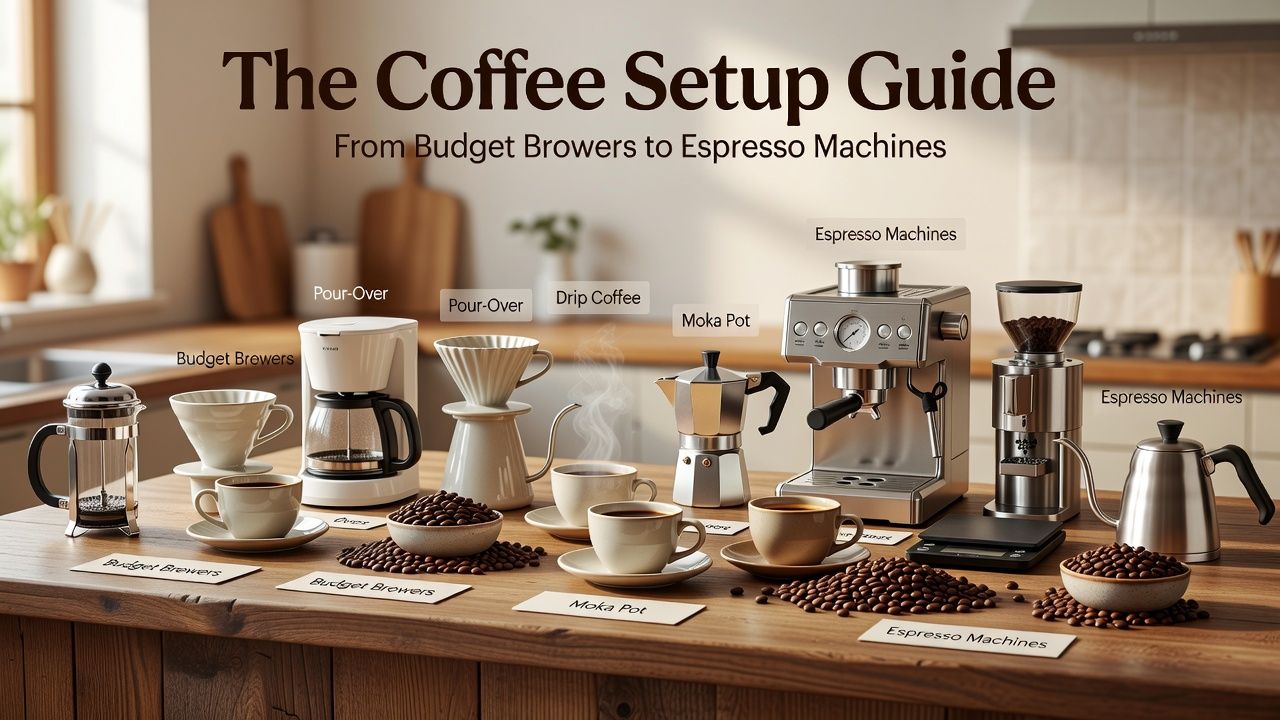
This guide is organized around that priority order rather than around machine price tiers, because the honest advice for almost everyone is: fix the grinder and the freshness before you touch the brewer. What follows covers what actually moves the needle, then walks through the equipment tiers from a basic pour-over to a full espresso setup, so you can spend where it counts for how you actually drink coffee, rather than for how the marketing suggests you should drink it.
01The three things that matter more than the machine
Freshness comes first because coffee begins losing its aromatic compounds within days of grinding and within a few weeks of roasting, regardless of storage. Whole beans, bought from a roaster with a roast date on the bag rather than a mystery “best by” date, and used within a few weeks of that roast date, will outperform a premium machine fed stale supermarket grounds every single time. Buy smaller quantities more often rather than a large bag that sits half-used for months, and store beans in an airtight container away from light and heat — not in the freezer for daily use, since repeated temperature cycling introduces moisture that degrades flavor faster than cool, dark, dry storage at room temperature actually does.
Grind quality is the second lever and the one most home setups get wrong. A blade grinder chops beans into inconsistent fragments — some near-powder, some barely cracked — and that inconsistency means part of your coffee over-extracts, turning bitter, while part under-extracts, turning sour and thin, in the very same cup, no matter how good the beans or the brewer happen to be. A burr grinder crushes beans between two abrasive surfaces to a consistent, adjustable size, and it is, without much competition, the single highest-impact purchase available to anyone serious about better coffee at home — often outranking the brewing method itself in terms of taste improvement per dollar spent.
The third lever, ratio, costs nothing beyond a kitchen scale. Most home coffee is brewed by eyeballed scoops, which is a surprisingly large source of inconsistency given how cheap the fix is. The commonly cited starting ratio is around 1:16 to 1:17, coffee to water by weight, roughly 60 grams of coffee per litre of water, adjusted to taste from there. Weighing rather than scooping removes a major source of variation between one cup and the next, and it’s the kind of habit that, once formed, takes barely any extra time but produces noticeably more consistent results morning after morning.
Spend here first
Before buying any brewing equipment: get whole beans with a roast date, buy a decent burr grinder, and use a kitchen scale for your ratio. Those three changes, made with the cheapest brewing method you already own, will improve your coffee more than swapping brewers ever will on their own.
02Water quality: the ingredient that’s ninety percent of the cup
It’s easy to overlook the fact that coffee is, by weight, overwhelmingly water, and the character of that water genuinely shapes the final cup in ways that are simple to fix and yet almost never discussed alongside grinders and beans. Water that’s very hard, carrying a heavy mineral load, can produce a flat, chalky-tasting extraction and, over time, contributes to limescale buildup that shortens the working life of both manual and electric brewing equipment. Water that’s very soft or heavily filtered to the point of removing essentially all minerals can extract coffee unevenly in the other direction, pulling out sourness without the fuller-bodied character minerals help carry. Strong off-flavors from an unfiltered tap — chlorine being the most common culprit — carry directly into the cup regardless of how good the beans and grind are.
For most households, a simple pitcher or tap filter is a sufficient and inexpensive fix, removing the most noticeable off-flavors and moderating extreme hardness without requiring anything as involved as a dedicated water-treatment system, which is really only worth the cost and complexity for someone running a genuinely serious home espresso setup or a small commercial operation. It’s a five-dollar-a-month habit that measurably improves the cup, and it protects the machine at the same time, which makes it one of the better returns on investment anywhere in this whole guide.
03Tier one: manual brewing, minimal spend
A pour-over dripper — a cone that sits over a mug or carafe, holding a paper or metal filter — is inexpensive, produces a clean, bright cup, and teaches you the fundamentals of extraction because you’re controlling the pour by hand rather than leaving it to an automated machine’s fixed program. It rewards a little technique: a slow, even pour in stages, starting with a “bloom” of just enough water to wet the grounds and let trapped carbon dioxide escape before the main pour, produces a noticeably better result than dumping all the water in at once and letting gravity do the rest of the work unattended.
The French press sits at the other end of this tier — full immersion rather than drip, producing a fuller-bodied, less clean cup since no paper filter catches the fine sediment that gives the brew its characteristic weight and texture on the tongue. It’s about as foolproof as brewing gets: coarse grounds, hot water, four minutes, press and pour, with very little room for the kind of technique errors that can throw off a pour-over. Both of these, paired with a decent burr grinder and a scale, will produce genuinely excellent coffee for a very modest total outlay, and they’re worth taking seriously as a permanent setup rather than a stepping stone toward something more elaborate — a great many committed coffee drinkers use nothing more involved than a pour-over dripper for years and never feel they’re missing anything meaningful by skipping an automated machine.
A third option worth mentioning in this tier is the AeroPress-style immersion brewer, which combines elements of both the pour-over and the French press — a short immersion period followed by a quick press through a paper filter, producing a clean cup with more body than a standard pour-over and considerably faster brewing time than either alternative. Its compact size and durability also make it a genuinely practical choice for travel, since it packs small and isn’t fragile the way glass carafes and ceramic drippers can be.
04Tier two: automated brewers
A drip coffee maker automates the pour-over principle, and the quality gap between a cheap one and a good one is larger than most people expect walking into a shop. The critical spec, often unlisted on budget machines, is whether the brewer reaches and holds the right water temperature, roughly 90–96 °C, and disperses water evenly over the grounds — cheap machines frequently brew too cool and too fast, under-extracting the coffee into a thin, sour result regardless of bean quality, no matter how carefully you’ve sourced and stored your beans. Machines certified by industry bodies for meeting these brewing standards are a reasonable shortcut if you don’t want to research individual models yourself, since the certification process specifically tests for temperature stability and contact time rather than relying on marketing claims alone.
Single-serve pod machines trade quality and cost-per-cup for convenience and consistency — useful for households with mixed preferences or for genuinely time-pressed mornings, but the coffee itself is a compromise, since pods can’t compete with fresh-ground beans on flavor, and the ongoing cost per cup is considerably higher than any other method on this list over time, sometimes dramatically so once you account for what the equivalent weight of whole-bean coffee actually costs. They’re a legitimate choice for convenience and for the specific problem of a household where different people want different things brewed at different times without waste; they’re not a quality upgrade, and it’s worth being honest with yourself about which of those two things you’re actually buying one for.
| Method | Upfront cost | Best for |
|---|---|---|
| Pour-over | Low | Clean, bright cups; hands-on ritual; single servings |
| French press | Low | Full body; near-foolproof; multiple servings |
| Immersion brewer | Low | Speed, travel durability, clean-but-bodied cup |
| Good drip machine | Medium | Hands-off mornings; consistent multi-cup batches |
| Pod machine | Low–medium, high per cup | Convenience; mixed household preferences |
| Espresso machine | Medium–very high | Espresso-based drinks; committed daily habit |
05Tier three: espresso, and the honest cost of it
Espresso is a genuinely different brewing method — hot water forced through very finely ground, tightly packed coffee under high pressure — and it’s the one tier where equipment quality has an outsized effect on outcome, because the process demands precision that manual methods simply don’t. Before buying a machine, it’s worth being honest about what espresso actually requires: a grinder capable of a fine, consistent espresso grind, a step up from what a standard burr grinder for drip coffee needs to achieve; a machine that can maintain stable pressure and temperature over the course of a shot; and a real technique-learning curve around dosing, tamping, and timing the extraction that takes weeks of practice, not one afternoon, to develop.
Skimping on the grinder while spending on the machine is the most common and most wasteful espresso mistake, since an inconsistent grind ruins an espresso shot more thoroughly than it ruins a pour-over, precisely because the fine grind and short contact time leave essentially no margin for the kind of inconsistency a coarser, longer-brewing method can absorb without much penalty. Entry-level espresso machines can produce a reasonable shot with practice, but there’s a real quality jump at higher price points tied to more stable temperature control and pressure consistency — this is one category where “you get what you pay for” genuinely holds, up to a point of diminishing returns well above what most home users need or would ever notice in a blind comparison.
Semi-automatic machines require you to control timing and, on some models, extraction manually, giving more control and demanding more skill; fully automatic and super-automatic machines handle more of the process for you at a real cost premium and some loss of control over the finer variables that espresso enthusiasts obsess over. If milk drinks matter to you, factor in a machine with a steam wand and expect a genuine learning curve for microfoam texture — frothing well is its own skill separate from pulling a good shot, and it’s arguably the harder of the two to master consistently, since it depends heavily on feel and repeated practice rather than any single measurable variable.
A moka pot deserves mention as a low-cost, stovetop alternative that produces a strong, espresso-adjacent, though technically different, coffee without anywhere near the cost or learning curve of true espresso equipment — a sensible way to explore whether you actually want the stronger, more concentrated style before committing to a full setup, and a genuinely excellent everyday brewer in its own right for many households that never feel the need to graduate beyond it.
06Storage: keeping beans fresh once you’ve bought them well
All the care taken to buy fresh, well-roasted beans is wasted if they’re then stored badly, and this is a genuinely common gap between good intentions at the point of purchase and what actually happens to the bag once it’s home. The main enemies of stored coffee are air, light, heat, and moisture, in roughly that order of importance, and a good storage container addresses the first two directly: opaque, airtight, and kept in a cool cupboard rather than on an open counter where morning light hits it daily. A dedicated coffee canister with a one-way valve, which lets the carbon dioxide that freshly roasted beans naturally release escape without letting outside air back in, is a genuinely worthwhile small purchase for anyone buying beans regularly, since it extends the window of peak freshness noticeably compared to a standard jar.
Buying in a quantity that will genuinely be used within two to three weeks, rather than a large bag that looks economical on a per-gram basis but sits half-finished for a month or more, is a more effective freshness strategy than any storage container alone can fully compensate for, since no amount of clever packaging fully halts the gradual loss of aromatic compounds once beans are roasted.
07Maintenance: cleaning, descaling, and equipment lifespan
Regular descaling, following the manufacturer’s schedule, is not optional maintenance for any machine that heats water repeatedly — skipping it is the most common reason a mid-range machine dies early, well before its components would otherwise have worn out, simply because mineral scale builds up inside heating elements and water pathways and eventually restricts flow or damages the heating mechanism outright. This connects directly back to the water quality section above: harder water means more frequent scale buildup and a more urgent, more regular descaling schedule than the same machine would need running on filtered water.
Beyond descaling, basic cleaning matters more than most owners realize: coffee leaves behind oils that turn rancid over time, and a brewer, carafe, or portafilter that’s only rinsed rather than actually washed will impart a stale, bitter note to every cup that follows, regardless of how fresh the beans are or how carefully the ratio was measured. A monthly deep clean with a proper coffee-equipment cleaner, alongside daily rinsing of any parts that contact the coffee directly, keeps any setup performing like new for years and is a genuinely cheap form of insurance against the slow, hard-to-diagnose decline in flavor that accumulates gradually enough that many people don’t notice it happening until they taste a truly fresh setup by comparison.
Bringing it together: the honest spending order for most people is grinder before brewer, freshness before either, and a scale before all of it — and only once those fundamentals are solid does upgrading the brewing method itself start to pay off proportionally to what it costs. Someone with a great burr grinder, fresh beans, and a pour-over cone is drinking meaningfully better coffee than someone with an expensive espresso machine, a blade grinder, and a bag of stale supermarket beans. Fix the cheap things first; the expensive machine, if you decide you want one, will actually be worth the money once everything feeding into it is right, and you’ll be far better placed to judge whether it’s genuinely improving your coffee or simply adding cost and complexity to a cup that was already good.