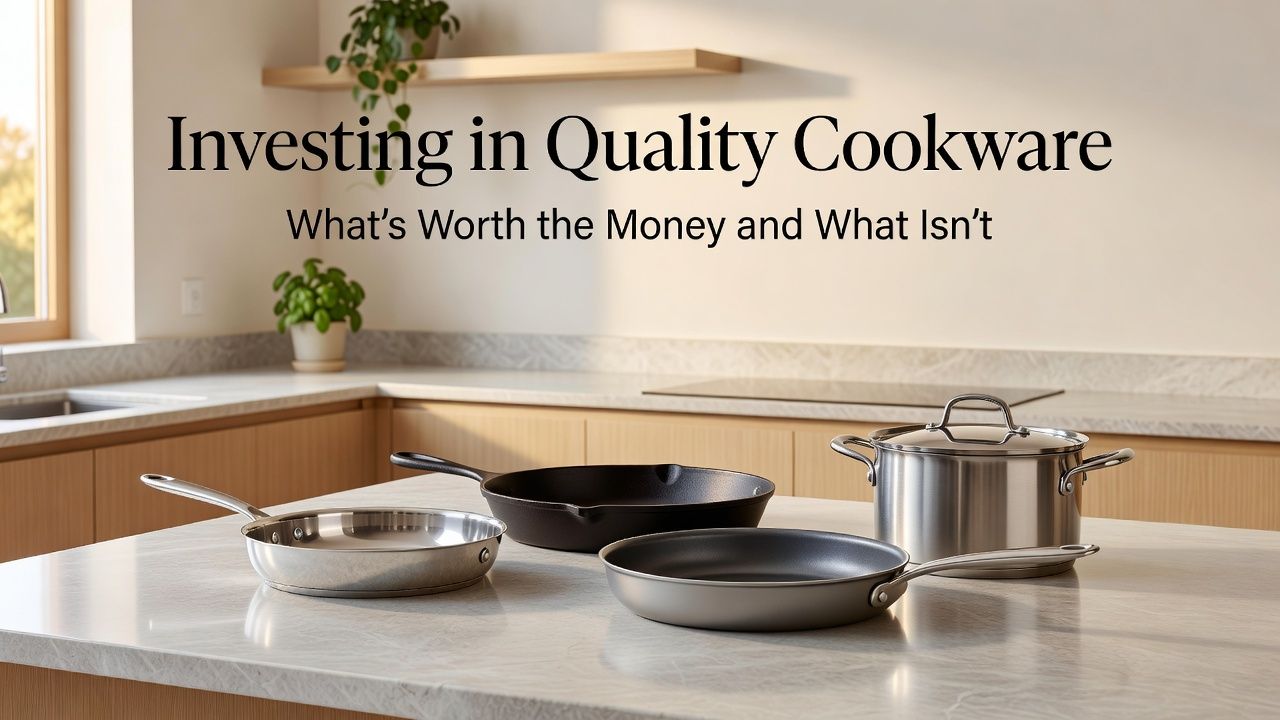
Kitchen Appliances & Gear
A cast iron pan can outlive you. A nonstick pan needs replacing in three years no matter what you paid. Knowing which is which changes how you should be spending.
Cookware spending follows a strange logic that rewards a little research and punishes none. Some pans genuinely improve with decades of use and represent one of the best value-per-year purchases in the entire kitchen. Others are wearing out from the moment you buy them regardless of price, and a $200 version will still need replacing in a few years, just as surely as a $20 one. Spending well means matching the right amount of money to the right category — splurging where durability rewards it, and refusing to overspend where physics guarantees a limited lifespan no matter the brand printed on the box.
The framework that makes this simple: ask whether a material can be restored to like-new condition through use and maintenance, or whether it degrades one-way regardless of care. Cast iron, carbon steel, and quality stainless steel fall in the first category — they can be re-seasoned, re-polished, and used for a lifetime, so the upfront cost amortizes over decades of daily use. Nonstick coatings fall in the second category — they degrade with heat and use no matter how gently you treat them, so paying a premium buys you the same limited lifespan as a mid-range version, just with a nicer logo and a heavier price tag attached to that same eventual expiry date.
01Worth the money: materials that last a lifetime
Cast iron is the clearest case for spending once and never again. A well-made cast iron skillet, seasoned and cared for, genuinely improves with decades of use — the seasoning layer builds up, the surface becomes more naturally nonstick, and pans passed down through generations remain fully functional, often better than when they were new. It’s heavy, retains heat exceptionally well, moves from stovetop to oven without concern, and costs relatively little for what it delivers over its lifespan. The one real caveat is weight, which matters for anyone with wrist or shoulder limitations, and enamelled cast iron, which trades some heat retention for not needing seasoning and being safer for acidic foods, is worth considering as an alternative for anyone who wants the material’s core benefits without the maintenance ritual.
Carbon steel is cast iron’s lighter, faster-heating cousin, favored by professionals for exactly that responsiveness — it heats and cools faster than cast iron, making it more forgiving for high-heat sautéing, while still building a seasoned patina over time and lasting decades with basic care. Quality stainless steel, particularly tri-ply or multi-ply construction with an aluminum or copper core sandwiched between steel layers, is essentially indestructible under normal use, doesn’t react with acidic foods the way plain iron or aluminum can, and goes from stovetop to oven to dishwasher without complaint. It doesn’t offer nonstick convenience, but that’s a fair trade for something that will still be excellent when your grandchildren inherit it, assuming you take even minimal care of it along the way.
Copper cookware, lined with tin or stainless steel, deserves a mention as the genuine luxury tier of the durable category: it offers unmatched responsiveness to temperature changes, prized by pastry chefs and sauce cooks specifically for how quickly it heats and cools in response to burner adjustments, and a well-cared-for copper pan can last many decades, with the lining periodically re-done by a specialist rather than the pan itself needing replacement. It’s genuinely expensive, genuinely heavy to polish and maintain, and genuinely overkill for most home cooking — but for someone who has already built out the practical core of a kitchen and wants one further step of refinement, it’s a defensible splurge rather than an impractical one, precisely because it too belongs to the restorable, lifetime category rather than the wearing-out one.
| Material | Realistic lifespan | Buy it for |
|---|---|---|
| Cast iron | Decades to generations | Searing, roasting, high-heat cooking, longevity |
| Carbon steel | Decades | Responsive high-heat sautéing, stir-frying, eggs once seasoned |
| Tri-ply / multi-ply stainless | Effectively indefinite | Sauces, browning, acidic foods, dishwasher-safe durability |
| Copper (lined) | Decades, with periodic re-lining | Precise heat control — genuinely a luxury purchase |
| Nonstick (any brand) | 2–5 years, regardless of price | Eggs, delicate fish, low-fat cooking — buy modest and replace on schedule |
02Not worth overspending on: nonstick
This is the category most likely to waste money, because it looks like every other cookware purchase but behaves completely differently underneath the surface. Nonstick coatings — whether traditional PTFE-based or newer ceramic-based formulations — degrade with heat exposure, metal utensil contact, and time, full stop, and this is true of every brand at every price point without meaningful exception. A premium nonstick pan will perform beautifully for a while and then, like every nonstick pan, start losing its coating and its stick-resistance. Paying three or four times as much doesn’t meaningfully extend that timeline; it mostly buys marginally better initial performance, a nicer handle, and sometimes a slightly more even heat distribution across the base, none of which changes the fundamental fact that the coating itself has a clock running on it from day one.
The financially sensible approach is to buy a solid mid-range nonstick pan, treat it gently — low to moderate heat, wooden or silicone utensils only, hand washing, no stacking other pans directly on top of it without a protective layer between them — and simply plan to replace it every few years as a matter of course rather than treating replacement as a failure or a sign you bought the wrong thing. Watch for the signs that retirement time has arrived: visible scratching or flaking of the coating, food sticking where it didn’t before, or any peeling at all. A damaged coating should be replaced rather than used further, since flaking material shouldn’t be eaten and a pan that’s lost its stick-resistance has lost its entire reason for existing as a nonstick product in the first place.
On the safety question specifically, current consumer guidance from bodies like the Consumer Product Safety Commission is worth checking directly if you have concerns about a specific coating type, since formulations and regulations have changed over the years and a general cookware guide isn’t the place for a definitive verdict on any one chemical compound. What’s not in dispute, regardless of coating chemistry, is the mechanical fact of wear: any nonstick surface, however it’s formulated, is a thin functional layer sitting on top of a base metal, and thin layers wear away with use in a way that solid metal simply doesn’t.
The budget rule
Spend big, once, on the pans that last decades: one good stainless sauté pan, one cast iron or carbon steel skillet, one solid stockpot. Spend modestly and repeatedly on nonstick, since no amount of money buys it out of a limited lifespan. Getting this split backwards is the single most common cookware money mistake home cooks make.
03The set trap
Matched cookware sets are one of the more effective pieces of kitchen marketing, and one of the least efficient ways to spend. A ten- or fifteen-piece set is priced to look like a bargain against buying each piece individually, but it almost always includes at least a few pieces most households rarely use — a second saucepan in a size that duplicates another, a specialty pan that gets pulled out twice a year, a lid that fits nothing else in the kitchen once its matching pot is retired. You end up paying for cabinet-clogging duplicates to get a modest discount on the two or three pieces you’ll actually use daily, which is a poor trade even when the headline discount looks generous on paper.
Buying piece by piece, in the material appropriate to each task, is both cheaper over time and produces a better-suited kitchen. A capable core is genuinely short: a large stainless sauté pan or skillet for most everyday cooking, a cast iron or carbon steel pan for searing and high heat, a nonstick pan for eggs and delicate items, a medium saucepan, a large stockpot, and one sheet pan or roasting pan. That’s six pieces, purchased individually in the right material for the job, and it will outperform most fifteen-piece sets while costing less over its lifetime and taking up considerably less cupboard space in the process.
There’s also a compounding cost to sets that isn’t obvious at purchase: because the pieces are matched and sold together, replacing just the one that wears out — almost always the nonstick pan in a mixed-material set — is awkward, since you’re either buying a replacement piece from the same range at a premium, or ending up with a mismatched collection anyway once the nonstick fails, which happens on a different timeline from everything else in the set regardless of how the marketing presents it as a unified purchase.
04What actually determines quality
Within any material category, a few physical characteristics predict performance far better than brand name or price alone. Thickness and weight matter enormously for even heating — a thin, light pan develops hot spots that scorch food in patches, while a heavier pan of the same material distributes heat more evenly and holds temperature better when food is added, which matters especially for anything you’re searing, since a thin pan’s temperature crashes the moment cold food hits it and takes longer to recover. For stainless steel specifically, look for multi-ply construction, typically three or five layers, rather than a single thin sheet of steel, since the aluminum or copper core sandwiched inside is what actually conducts heat well — plain stainless alone is a genuinely poor heat conductor and a pan made from it alone, without a conductive core, will heat unevenly no matter how well it’s otherwise built.
Handle attachment is worth checking physically where you can: riveted handles are more durable than welded or screwed ones, and a handle that feels loose or flimsy in the shop will only get worse with years of use and repeated heating and cooling cycles. Lid fit matters more than it seems for anything you’ll braise or simmer, since a poorly fitting lid lets more moisture escape than intended and can throw off cooking times in recipes that assume a reasonably tight seal. And oven-safety ratings vary by handle material even within otherwise similar pans — check the stated maximum temperature if you plan to move a pan from stovetop to oven regularly, since some handles, particularly certain plastics and composite materials, have much lower limits than the pan body itself, and exceeding that limit can mean a melted or warped handle even though the cooking surface is completely fine.
Base flatness is a subtler but genuinely important quality signal, particularly for induction cooktops, which require good, flat contact with the cooking surface to heat efficiently. A warped or slightly domed base, common in cheaper pans, sits unevenly on the burner and both wastes energy and heats unevenly regardless of how good the pan’s wall material otherwise is. Running a straightedge or ruler across a pan’s base before buying, where the shop allows it, is a quick and genuinely useful check that most buyers never think to do.
05Buying secondhand and vintage, done wisely
Because cast iron, carbon steel, and quality stainless are restorable rather than degrading, they’re also genuinely excellent candidates for secondhand and vintage purchasing, often at a fraction of new retail prices for equal or superior quality to current production. A rusty, neglected vintage cast iron pan found at a flea market or inherited from a relative is, in the large majority of cases, entirely salvageable: rust can be scrubbed off with steel wool, the pan re-seasoned from scratch with a few rounds of thin oil layers baked on in the oven, and the result is often a better piece of cookware than an equivalent new purchase, since a lot of vintage cast iron was cast with a smoother finish than much contemporary production.
Nonstick pans are the one clear exception where secondhand buying is genuinely inadvisable: since the coating degrades on a fixed clock regardless of care, a secondhand nonstick pan is very likely already partway or fully through its useful life, and there’s no way to restore a worn nonstick coating the way you can restore cast iron seasoning or polish stainless steel back to a good working surface. For this one category specifically, buying new and modest is the more sensible path than hunting for a secondhand bargain.
07Sizing before material: a step people skip
Before deciding what material to buy in any given category, it’s worth pausing on size, since a beautifully made pan in the wrong size for how you actually cook is nearly as wasteful a purchase as a poorly made one in the right size. A single person or couple cooking mostly for two rarely needs anything larger than a 10-inch skillet and a 3-quart saucepan for daily use, while a household regularly cooking for four or more, or one that entertains often, genuinely benefits from a 12-inch skillet and a larger stockpot as the everyday defaults instead. Buying the largest available size “to be safe” is a common and understandable instinct that often backfires in practice: an oversized pan used for a small portion heats a large area of empty metal along with the food, wastes energy, and frequently produces worse searing results than a properly sized pan would, since the food doesn’t make contact with enough of the hot surface to brown evenly.
The reverse mistake, buying too small out of a desire to save money or cupboard space, shows up constantly as crowded pans that steam food instead of browning it, a problem covered in more depth in articles on searing and sautéing technique but worth flagging here as a purchasing decision, not just a cooking one. A reasonable approach for a kitchen being built out from scratch is to buy one properly sized pan per core category first, live with it for a season of real cooking, and only then decide whether a second size in that same material genuinely earns its place, rather than guessing at the full range upfront and discovering later that half the guesses were wrong for how the household actually eats.
08Making it last
Even durable cookware needs basic care to actually reach its potential lifespan. Cast iron and carbon steel want to be dried immediately after washing and lightly oiled to prevent rust, and both develop their prized nonstick seasoning through repeated cooking with fat rather than through any special product bought specifically for the purpose. Stainless steel tolerates a dishwasher but benefits from hand washing for anything with stuck-on food, since a good soak and a wooden or nylon scrubber usually beats scrubbing power that can dull a polished finish over years of repeated dishwasher cycles. Across all materials, avoid extreme thermal shock — plunging a screaming-hot pan into cold water can warp or crack it, particularly cast iron and enamelled surfaces — and let pans cool somewhat before washing rather than rushing straight from stove to sink.
The broader financial logic is worth restating plainly, because it cuts against the instinct to spread a cookware budget evenly across every piece a kitchen might contain. A $200 cast iron or stainless pan used weekly for thirty years costs roughly $7 a year, before accounting for the fact that it may well still have decades of life left in it at the end of that thirty-year mark. A $200 nonstick pan replaced every three years, at that price point, costs far more annually than a $40 version replaced on the same schedule, for no meaningful gain in longevity, since both are subject to the same coating-degradation clock regardless of price. Spend where durability rewards you, spend modestly where it can’t, skip the matched set, and buy the six or seven pieces you’ll actually use — in the right material for what they’ll do. That combination gets you a genuinely excellent kitchen for less than most starter sets cost, and most of it will outlast the kitchen it’s sitting in, quite possibly outlasting more than one kitchen if you ever move house.