Kitchen Appliances & Gear
They’re the same technology sold two different ways. Here’s what actually differs, and which one earns counter space in your specific kitchen.
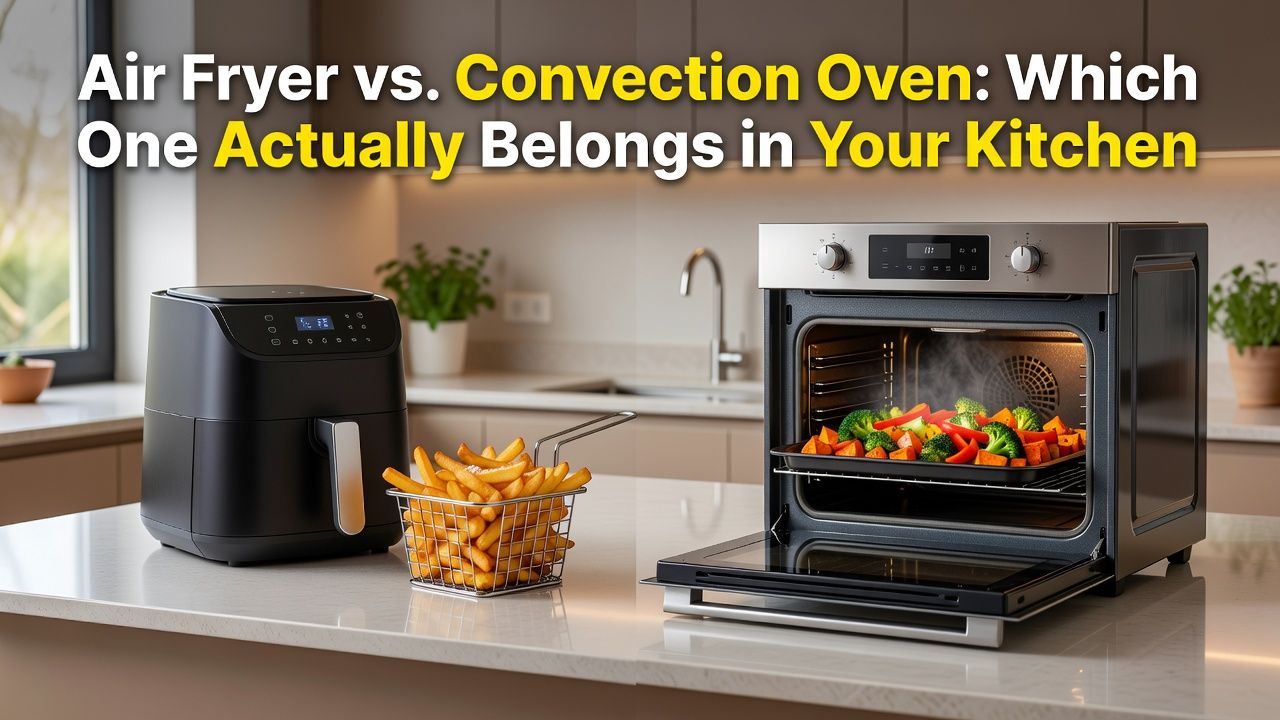
Here’s the fact that undermines most of the marketing around air fryers: an air fryer is a small convection oven. Both work the same way — a fan circulates hot air around the food, stripping away the insulating layer of still air that normally slows cooking and dulls browning, so food crisps and browns faster than it would in a still, conventional oven. There is no special frying technology inside an air fryer basket. There’s a heating element, a fan, and a compact chamber. Understanding this one fact resolves most of the confusion around whether you need one, because the real question was never “air fryer or oven” — it’s “do I want this convection effect delivered in a small dedicated box, or in the oven I already own.”
That reframing matters because it changes what you’re actually evaluating. You’re not choosing between two different cooking technologies. You’re choosing between a compact, fast-preheating, easy-to-clean single-purpose appliance and a larger, slower-preheating, higher-capacity multi-purpose one that may already have the same fan built in. Once that’s clear, the decision comes down to your kitchen’s specific constraints — counter space, household size, what you already own, how you actually cook week to week, and how often you’d realistically use the smaller option rather than how often you imagine you would when standing in a shop weighing up the purchase.
01What’s actually different, mechanically
If both appliances use the same fan-and-heat principle, the practical differences come down to geometry and scale, and they matter more than people expect. An air fryer basket is small, which means the fan and heating element sit close to the food and the chamber heats up almost immediately — most preheat in two to three minutes, against ten or more for a full-size oven. That proximity also means more intense, more even air movement per item, which is why air fryers tend to produce slightly crispier results on small batches than a convection oven achieves on the same food cooked at the same temperature for the same time.
The trade-off is capacity. That same small chamber that crisps so efficiently also means you’re working in small batches — a single layer of florets or fries, not a sheet pan’s worth. Try to cook for four people in a basket sized for two and you lose the entire advantage: crowded food steams instead of crisping, exactly as it would in any oven that’s asked to do more than it comfortably can. A full-size convection oven, run with its fan setting engaged, gives you large multi-rack capacity with a similar, if slightly gentler, crisping effect, at the cost of a longer preheat and a larger footprint that’s already installed and paid for in your kitchen.
There’s a subtler mechanical difference worth knowing too: airflow pattern. A standalone air fryer typically pulls air from the top and circulates it in a fairly tight, contained loop around a basket that sits close to the heating element on most models, which is part of why it browns so aggressively and so quickly. A convection oven’s fan, usually mounted at the back of the cavity, pushes air across a much larger volume, which is gentler per square inch of food but covers far more food overall. Neither pattern is objectively better; they’re suited to different jobs, which is exactly why matching the appliance to the job, rather than assuming one is a strictly superior version of the other, is the right way to think about this.
| Factor | Air fryer | Convection oven |
|---|---|---|
| Preheat time | 2–3 minutes | 10–15 minutes |
| Batch size | Small — 1–2 servings typically | Large — full sheet pans, multiple racks |
| Crisping power | Very high, per item | Good, slightly gentler |
| Counter footprint | Real, and permanent | None — it’s already built in |
| Energy use per meal | Lower for small portions | Higher for small portions, efficient for large ones |
| Cleanup | Small basket, dishwasher-safe usually | Larger surfaces, more of them |
02Where each one genuinely wins
The air fryer’s strongest case is small-batch speed for one or two people: reheating leftovers so they crisp back up instead of going soggy in a microwave, a quick portion of frozen fries or a few chicken wings, weeknight cooking for a household of one or two where firing up a full oven feels like overkill for the amount of food actually involved. The fast preheat and the tight air circulation genuinely deliver a better result than a full oven for these specific jobs, and the smaller basket is easier to load, unload, and wipe out than an oven rack and a full sheet pan, which matters more than it sounds like it should on an ordinary weeknight when the whole point is minimizing effort.
The convection oven wins decisively on anything that needs volume or that benefits from a larger, more even cooking environment: a full tray of roasted vegetables for a family, a whole chicken, a sheet of cookies, anything where batch-cooking or feeding more than two people is the point of the exercise. It also wins for anyone genuinely tight on counter space, since the fan setting most modern ovens already include delivers a comparable effect without adding another appliance to store, clean, and find a plug for, and without adding another single-purpose object competing for the same limited cupboard space as everything else in the kitchen.
There’s a middle scenario worth naming explicitly, because it’s common and it’s where the decision genuinely gets harder: a household of three or four that wants small-batch convenience on some nights and full-batch capacity on others. For this household, the honest answer is often both, if space allows, or neither as a standalone purchase and instead leaning on the oven’s convection setting for large cooking and accepting a slightly longer preheat on the nights a smaller portion is wanted. There’s no dishonor in deciding a second appliance simply isn’t worth the space for a household that falls in this middle ground; it’s a genuinely reasonable call, not a compromise to feel bad about.
Quick verdict
Check your oven’s settings before buying anything. If it already has a “convection” or “fan” mode, you own most of what an air fryer offers — just at a larger scale and a slower preheat. Buy the standalone unit only if you specifically want the small-batch speed, or if your household is one or two people who’ll use it several times a week rather than occasionally.
03What air frying doesn’t do
The name creates expectations the appliance can’t meet, and it’s worth being precise about the gap. Air frying does not replicate deep frying. Deep-fried food is cooked by full immersion in hot fat, which conducts heat far more efficiently than moving air, produces a distinctive crust texture from the fat penetrating the surface, and cooks evenly on every side simultaneously without needing to be flipped or shaken partway through. An air fryer, using a thin coating of oil and moving air, gets meaningfully closer to that texture than a conventional oven does — which is a genuine and useful achievement — but it is not the same food, and dishes that depend on true deep-fat frying, like proper battered fish, doughnuts, or tempura, don’t fully translate no matter how the settings are adjusted.
It’s also worth being clear-eyed about the health framing that sells a lot of these units. Air frying does use substantially less oil than deep frying, which for foods you’d otherwise deep fry is a real reduction in added fat. But it’s not a transformation of a food’s basic nutritional character — frozen fries air-fried are still fried potato with salt, just with less oil than the deep-fried version, and reheating leftover pizza in an air fryer doesn’t make it a different food category. General guidance on balanced eating patterns is available from resources like Harvard’s Nutrition Source, and it’s worth treating appliance marketing claims about health with the same skepticism you’d apply to any product copy making similarly strong claims.
A related limitation worth flagging: air fryers handle dry, relatively firm foods well — vegetables, breaded items, previously frozen foods, reheated leftovers — and handle wet-battered foods, delicate fish, and anything with a loose or runny coating poorly, since the coating tends to drip through the basket or fail to set properly without full immersion in fat. Knowing this in advance saves a disappointing first attempt at something the appliance was never really built to do well.
04Buying and using either one well
If you’re buying a standalone air fryer, capacity is the single most consequential spec — measured in litres or quarts — and it’s worth sizing up from what seems necessary, since the temptation to overcrowd a small basket is exactly what produces disappointing, steamed-rather-than-crisped results. A basket-style unit with a removable, dishwasher-safe basket is generally easier to keep clean than an oven-style unit with a door and racks, though the oven-style versions typically offer more capacity and versatility, closer in spirit to a genuine small convection oven than a basket-style fryer. Check the wattage and preheat time if speed is your main reason for buying, and look at noise level if it’ll live on a counter near where people sit and talk, since some models run considerably louder than others at full fan speed.
Using either well comes down to the same short list of convection-cooking rules. Don’t crowd the basket or tray — air needs to circulate around each piece, and a single layer with space between items is what produces the crisping effect either appliance is good at. Pat food dry before cooking, since surface moisture has to evaporate before browning can start, and skipping this step is the single most common reason home cooks report soggy results from either appliance. Use a light coating of oil rather than none at all for most vegetables and proteins, since a small amount of fat improves browning and flavor even in a low-oil method and the appliance’s marketing shouldn’t push you toward using none at all. Shake or flip partway through for anything that isn’t a single flat layer, and check food a few minutes earlier than a conventional recipe suggests, since the stronger air circulation in a compact chamber genuinely cooks faster than most printed recipes, written with a standard oven in mind, will account for.
Basic appliance safety is worth a mention too: keep either unit clear of flammable materials, don’t leave any hot appliance unattended for extended periods, and follow the manufacturer’s cleaning instructions, since built-up oil residue in any heating appliance is a fire risk over time and is one of the more common causes of small kitchen appliance fires reported to safety authorities. The U.S. Consumer Product Safety Commission publishes general guidance on kitchen appliance safety and recall information, worth a check if you’re buying a specific model secondhand or are unsure about a unit you already own and its recall history.
05The energy question, honestly
One genuine advantage of the air fryer that gets less attention than it deserves is energy use for small portions. Heating a full-size oven cavity to roast a single portion of vegetables is genuinely wasteful in energy terms, since a large volume of air has to be brought up to temperature and maintained there for the whole cooking time regardless of how little food is actually inside. A small air fryer chamber reaches temperature faster and heats a fraction of the air volume, which meaningfully reduces energy consumption for small-portion cooking specifically. This advantage disappears, and can even reverse, once you’re cooking at a volume that would otherwise require multiple air fryer batches run back to back, since running the small appliance three times in sequence can use more total energy and more total time than a single oven load cooking everything at once.
The practical takeaway is that the energy case for an air fryer is strongest for exactly the same households where the capacity case is strongest: those cooking small portions regularly. For anyone weighing the purchase partly on efficiency grounds, this is worth factoring in honestly rather than assuming either appliance is universally more efficient, since the true answer depends entirely on portion size and batch frequency rather than being a fixed property of either appliance.
06Food-by-food: where the two genuinely differ in results
It’s worth walking through a few specific, commonly cooked foods, because the abstract comparison above becomes much more useful once it’s grounded in actual dishes people cook on a regular basis. Frozen fries are the classic air fryer showcase, and for good reason: the tight, close air circulation genuinely produces a crisper, more evenly browned result on a small portion than a full oven does in the same time, largely because the food sits so close to the heating element and the moving air has so little volume to circulate through. Scale that same bag of fries up to a full family portion, though, and the calculus flips — a sheet pan spread in a single layer in a full oven with the fan running will out-crisp an overcrowded air fryer basket every time, because crowding defeats the very airflow the appliance depends on.
Chicken wings behave similarly: superb in an air fryer for a portion of eight to twelve, genuinely comparable to a deep-fried result in crispness if not in flavor, but a party-sized batch of two or three dozen wings is a multi-batch slog in a small air fryer versus a single, unattended tray in a full oven. Roasted vegetables scale the same way — excellent for a side dish for two in the air fryer, better handled by the oven once you’re feeding a table of six and need several trays’ worth of even browning without babysitting three consecutive air fryer loads.
Baked goods are where the air fryer’s small chamber becomes a genuine liability rather than a neutral trade-off: cakes, most cookies in any real quantity, and bread all want the more even, gentler, larger heat environment of a proper oven, and while some air fryer models include an accessory pan intended for baking, results are inconsistent and the appliance was never designed with baking’s precise heat and rise requirements in mind the way an oven, even a compact one, was.
07The honest bottom line
There’s no universally correct answer here, only a correct answer for your kitchen. A household of one or two, cooking small portions on a weeknight, in a kitchen where a compact fast-heating box genuinely gets used several times a week, will get real value from a standalone air fryer, in both convenience and modest energy savings. A household cooking for more people, with an oven that already has a fan setting, is very likely paying for counter space and cupboard storage to duplicate something they already own, and would likely get more genuine day-to-day value from spending that same money elsewhere in the kitchen.
Check your oven before you check the reviews — it’s the fastest way to answer this question honestly, and it costs nothing but a minute spent reading the dial or the manual you probably already have somewhere in a drawer. If the fan setting is there and you’ve simply never used it, try it for a week on the kind of food you’d otherwise consider an air fryer for, and let that actual experience, rather than any marketing copy, tell you whether a second appliance is really solving a problem you have or merely one you’ve been told you have.