Kitchen Renovation & Home Improvement
One question determines almost everything else: are your cabinet boxes actually sound? Answer that honestly before comparing a single price.
Cabinetry typically represents the single largest line item in a kitchen renovation budget, which makes the refacing-versus-replacement decision one of the most financially consequential choices in the whole project — and also one of the most commonly made for the wrong reasons. People often choose based on which word sounds more impressive, or based on a contractor’s default recommendation, rather than based on the one question that should actually decide it: is the underlying structure of your existing cabinets — the boxes, not the doors — still genuinely sound.
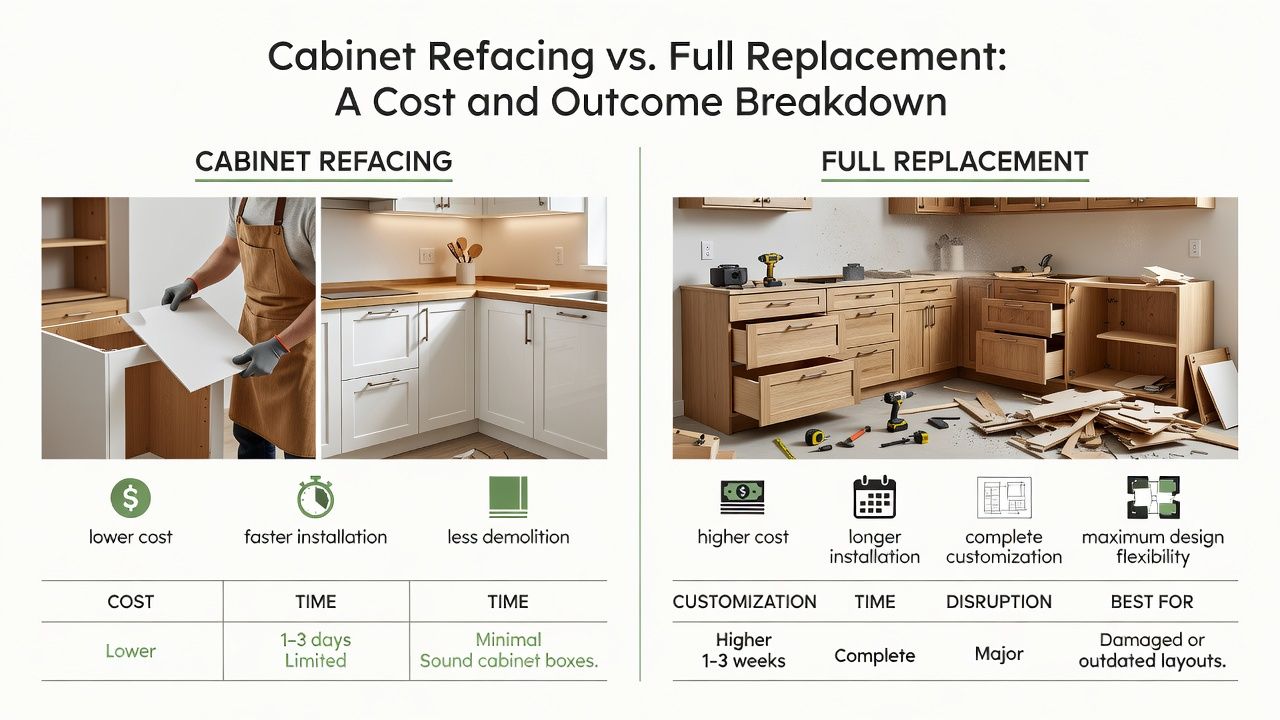
Refacing keeps the existing cabinet boxes in place and replaces only what you see: new doors, new drawer fronts, and a thin veneer or laminate applied to the visible box surfaces, along with new hardware throughout. Full replacement removes everything down to the wall studs and installs entirely new cabinet boxes along with new doors and hardware. The cost difference between the two is substantial — refacing typically runs at a meaningful fraction of full replacement cost — but that cost comparison is meaningless if the boxes underneath aren’t sound enough to reface, which is why the honest first step in this decision has nothing to do with money and everything to do with an honest structural assessment carried out before any pricing conversation begins.
01The question that decides everything: are the boxes sound?
Refacing only works, and only makes financial sense, when the existing cabinet boxes are structurally sound and correctly positioned for how you want the kitchen to function going forward. This means checking several specific things, ideally with a level, a flashlight, and an honest eye rather than a hopeful one that’s already decided refacing is the answer before the inspection even starts. Open every door and drawer and check that boxes are square and plumb, not warped, not visibly out of alignment, not requiring the door to be forced to close properly against resistance. Check for water damage, especially around the sink base cabinet and any cabinet near the dishwasher or refrigerator water line, since water-damaged particleboard swells, softens, and loses structural integrity in ways that veneer over the top will not fix and may actually hide from view, which is a genuine safety and durability concern rather than merely a cosmetic one. Check drawer boxes specifically, since these take the most repeated mechanical stress of anything in a kitchen and are often the first thing to fail even when the outer cabinet box itself is still perfectly fine.
Beyond physical condition, layout suitability matters just as much: refacing keeps your existing footprint, so if your current layout has a genuine functional problem — insufficient storage, an awkward workflow, cabinets in the wrong places relative to your appliances — refacing preserves that problem along with everything you like about the kitchen, since it’s purely a cosmetic and hardware refresh, not an opportunity to reconfigure anything about where the boxes themselves actually sit. If the honest answer to the structural check is that boxes are solid, square, and free of water damage, and the existing layout genuinely works for how you use the kitchen day to day, refacing is a legitimate option worth serious consideration. If boxes are compromised, water-damaged, badly out of square, or the layout itself needs to change to fix a real problem, refacing is not a shortcut around those problems — it’s a way of spending real money to put a new face on problems that will still be there underneath, waiting to resurface.
The five-minute box check
Open every cabinet and drawer. Check corners for square with a level. Press on the bottom panel under the sink and around the dishwasher for softness or give, a sign of water damage. Check that drawers slide smoothly without racking or binding. If more than a couple of boxes fail this check, or if the sink base shows any softness, get a contractor’s structural opinion before assuming refacing is the cheaper path — it may not be, once the compromised boxes are properly addressed.
02What refacing actually involves, and what it delivers
A typical refacing project involves several coordinated steps: existing doors and drawer fronts are removed and either replaced entirely with new ones or, less commonly, refinished if they’re in excellent condition and simply need a color change rather than an outright swap; the visible surfaces of the cabinet boxes, the face frames and any exposed sides, are covered with a thin wood veneer or a rigid thermofoil or laminate material matched to the new doors; and all hardware, including hinges, drawer slides, and pulls, is replaced with new throughout the kitchen. The interior of the boxes generally stays as-is, unfinished and unseen behind the doors, since refacing is fundamentally about what shows to the eye rather than what’s hidden away.
Done well, with quality doors and a properly applied veneer, refacing produces a result that’s visually very difficult to distinguish from full replacement — the kitchen looks completely refreshed, the door style and color can change entirely from what was there before, and new soft-close hinges and full-extension drawer slides genuinely transform the daily feel of opening and closing everything, even though the boxes underneath are the same ones that were there before the project started. The timeline is also a real advantage: refacing typically takes a matter of days rather than the weeks a full replacement demands, and because the boxes stay in place, the kitchen is usable, with some disruption, for much more of the process, which matters enormously for households without an alternative kitchen or living arrangement to fall back on during the work.
| Factor | Refacing | Full replacement |
|---|---|---|
| Relative cost | Roughly a third to half of replacement | Full cost of new cabinetry throughout |
| Typical timeline | Days | Weeks |
| Layout changes | Not possible — keeps existing footprint | Fully flexible |
| Interior storage upgrades | Limited to what fits existing boxes | Fully customizable |
| Resale value impact | Good, if done well | Strongest, especially with layout improvements |
| Depends on | Sound existing boxes and workable layout | Nothing — starts fresh regardless of existing condition |
03What full replacement buys that refacing can’t
Full replacement is the only option that addresses a genuinely flawed layout, and this is the single biggest reason to choose it over refacing even when the existing boxes are structurally fine and would otherwise pass every check listed above with no trouble. If your kitchen’s cabinets are in the wrong places for how you actually cook — insufficient storage near where you prep, an awkward gap between the sink and the stove, no logical place for trash and recycling, corner cabinets that waste enormous unusable space that nothing can reasonably reach — refacing simply preserves all of that, because it works within the existing box positions by definition and can’t move a single wall-mounted box an inch in any direction. Full replacement is the moment to fix these problems, since new boxes can be sized, positioned, and configured specifically around a corrected layout, informed by the functional planning principles that organizations like the National Kitchen & Bath Association publish for kitchen workflow and storage design generally.
Interior storage technology has also advanced substantially over the past couple of decades, and full replacement is the only path that lets you take full advantage of it: deep drawers instead of lower cabinets with a single fixed shelf, pull-out pantry units, built-in trash and recycling pull-outs sized to fit exactly what your household actually generates, corner solutions like lazy susans or diagonal pull-out systems that actually make corner space usable rather than wasted, integrated charging stations and appliance garages, and customized drawer dividers and inserts sized for your specific cookware collection rather than a generic average. Some of these can be retrofitted into existing boxes during a refacing project to a limited degree, but the level of customization and the range of options available is dramatically greater when the boxes themselves are being built or selected new, since you’re not constrained by what physically fits inside an opening that was designed decades ago for different assumptions about how a kitchen should be organized.
Full replacement is also the right choice, regardless of the cost difference, whenever the existing boxes fail the structural check outlined above, whether from water damage, warping, or genuine structural compromise discovered during a careful inspection. In these cases, refacing isn’t actually the cheaper option once you account for the cost of properly repairing or reinforcing damaged boxes before applying new veneer over them, and doing so risks papering over a problem that will resurface, sometimes literally as the veneer bubbles or peels, within a few years as the underlying damage continues to progress beneath the new surface.
04The middle path: hybrid approaches
The choice isn’t always binary across the whole kitchen, and a hybrid approach is worth genuine consideration rather than being treated as an awkward, unsatisfying compromise between two purer options. It’s entirely reasonable to fully replace cabinets in one section of the kitchen, say, around the sink, where a layout change or water damage makes replacement genuinely necessary, while refacing sound boxes elsewhere in the same kitchen, provided the new and refaced doors are ordered from the same source in a matching style and finish so the transition between the two zones is invisible to a casual observer. This is particularly sensible when only part of a kitchen has a genuine problem, such as a water-damaged sink base or an awkward corner, while the rest of the cabinetry is in good structural shape and the layout works perfectly well as it stands.
Another middle-ground option, distinct from both refacing and full replacement, is a simple door-and-hardware swap without the veneer step at all, keeping the boxes and their existing finished surfaces exactly as they are, assuming the existing box finish is in acceptable condition and doesn’t need covering up. This is less transformative than full refacing since the visible box surfaces stay as they were, but it’s the least expensive option that still delivers new hinges, new drawer glides, and a genuinely different look from new door styles and finishes, worth considering for a household on a tight budget where boxes are in good cosmetic as well as structural condition and don’t really need the additional veneer layer to look presentable.
05Quality signals to check regardless of which path you choose
Whether refacing or replacing, several specific quality markers separate a result that holds up for decades from one that starts looking tired within a few years, and it’s worth checking for these explicitly rather than assuming any contractor’s default materials are equivalent to any other’s. For doors, solid wood or a high-quality engineered wood core with a durable finish outlasts thin, low-grade veneers that can chip or peel at edges and corners, particularly around handle cutouts and other high-contact areas that see repeated daily use. For hardware, soft-close, full-extension drawer slides and quality hinges are worth the modest incremental cost over basic builder-grade hardware in either scenario, since this is one of the most noticeable quality differences in daily use regardless of whether the boxes underneath are old or new.
For refacing specifically, ask what veneer material is being used and how it’s being applied, since a properly adhered, high-quality veneer with well-finished edges looks and performs very differently from a thin, poorly bonded laminate that can bubble or peel over time, particularly at corners and edges that take the most physical contact from daily use over the years. Ask to see examples of the specific contractor’s completed refacing work in person if possible, ideally a project that’s a few years old rather than freshly finished, since this is where the difference between quality and poor-quality refacing becomes genuinely visible in a way a brand-new sample simply can’t demonstrate. For full replacement, check whether cabinet boxes are made from plywood or a lower-grade particleboard, since this affects both durability and the boxes’ ability to hold screws securely for hardware and wall mounting over the cabinet’s entire lifetime, a detail worth asking about explicitly, since it’s not always obvious from a showroom display which construction grade you’re actually being quoted for your specific project.
06The often-overlooked question of countertops and appliances
A detail that trips up a surprising number of refacing projects is the interaction between cabinet decisions and everything that sits on top of or beside them. If the countertops are staying in place through a refacing project, it’s worth confirming that the new door and drawer front dimensions, along with any new hardware, won’t create clearance problems with the existing counter overhang or with appliances mounted beneath the counter line, such as a dishwasher or a built-in microwave drawer. This is rarely a major problem, but it’s exactly the kind of small oversight that turns a tidy few-day refacing project into an unexpectedly extended one if it’s discovered only once the new doors have already arrived and don’t quite clear an existing obstruction.
Similarly, if you’re planning to replace countertops at the same time as either refacing or replacing cabinets, sequencing matters: cabinets, whether refaced or entirely new, should generally be finalized before a countertop template is taken, since even a refacing project’s new door and drawer fronts can shift dimensions slightly from the originals, and a countertop template taken too early against the old configuration can result in a poor fit once the new fronts are installed.
07Getting quotes and avoiding the common trap
The most common financial trap in this decision is committing to refacing based on a general cost estimate before a contractor has actually inspected the condition of your specific boxes, and then discovering mid-project that a meaningful number of boxes need repair or replacement anyway, at which point you’re paying for both the refacing veneer and the box repair, which can erase much or all of the cost advantage refacing was supposed to offer in the first place. The right sequence is to get a contractor’s honest structural assessment of your existing boxes before finalizing a decision or a budget, not after signing a contract based on a generic per-linear-foot estimate that quietly assumes sound boxes as an unstated baseline.
Get itemized quotes for both paths if you’re genuinely uncertain, since seeing the real numbers side by side for your specific kitchen, including any necessary box repairs factored honestly into the refacing quote rather than treated as a hidden surprise, is far more useful than comparing generic percentage estimates found somewhere online. And ask directly and explicitly whether the contractor recommending one path over the other has a structural or financial reason for that recommendation specific to your kitchen, or whether it’s simply the service they specialize in and therefore default to recommending regardless of what would genuinely suit your situation best; a contractor who only offers refacing services has an obvious incentive to tell you refacing will work, regardless of what an unbiased structural assessment might otherwise show if performed by an independent party.
The decision, boiled down, comes to this: refacing is a genuinely excellent option, not a lesser compromise, when your existing boxes are sound and your layout works, delivering most of the visual and functional transformation of new cabinetry at a meaningful fraction of the cost and disruption of starting over. Full replacement is the right and necessary choice when boxes are compromised, when the layout itself needs to change, or when you want the full range of modern storage customization that only new boxes can provide from the ground up. Neither is objectively better across the board — they’re the right tool for different starting conditions — and the entire decision hinges on an honest, ideally professional, assessment of what’s actually behind your current cabinet doors before a single dollar is committed to either path.