Meal Planning & Household Economics
A genuinely useful pantry isn’t the biggest one. It’s the one where every item earns its shelf space by actually getting used before anything expires.
A well-stocked pantry is genuinely one of the highest-leverage investments available to a home cook, because it’s the difference between “I need to make a special trip to the store to cook dinner” and “I can make a genuinely good meal from what’s already here without leaving the house.” But there’s a common failure mode worth naming upfront, since it undermines the whole point of the exercise: a pantry stocked with everything that seemed like a good idea at some point, much of it purchased for a single recipe and never used again, taking up shelf space and eventually getting thrown out well past any reasonable freshness window. That’s not a well-stocked pantry, it’s an expensive storage unit for eventual, quiet waste that nobody notices accumulating until the cupboard is cleared out.
The distinction that actually matters is between what genuinely belongs in long-term pantry storage, shelf-stable items with a long, reliable useful life that form the backbone of a large range of dishes, and what should be bought fresh as needed, because it has a short useful life or because its quality degrades meaningfully with storage time in a way that undermines the whole point of having it on hand in the first place. This guide draws that line deliberately, category by category, and covers the storage and rotation habits that keep a pantry genuinely useful rather than becoming a graveyard of good intentions and half-remembered impulse purchases.
01The genuine long-term core
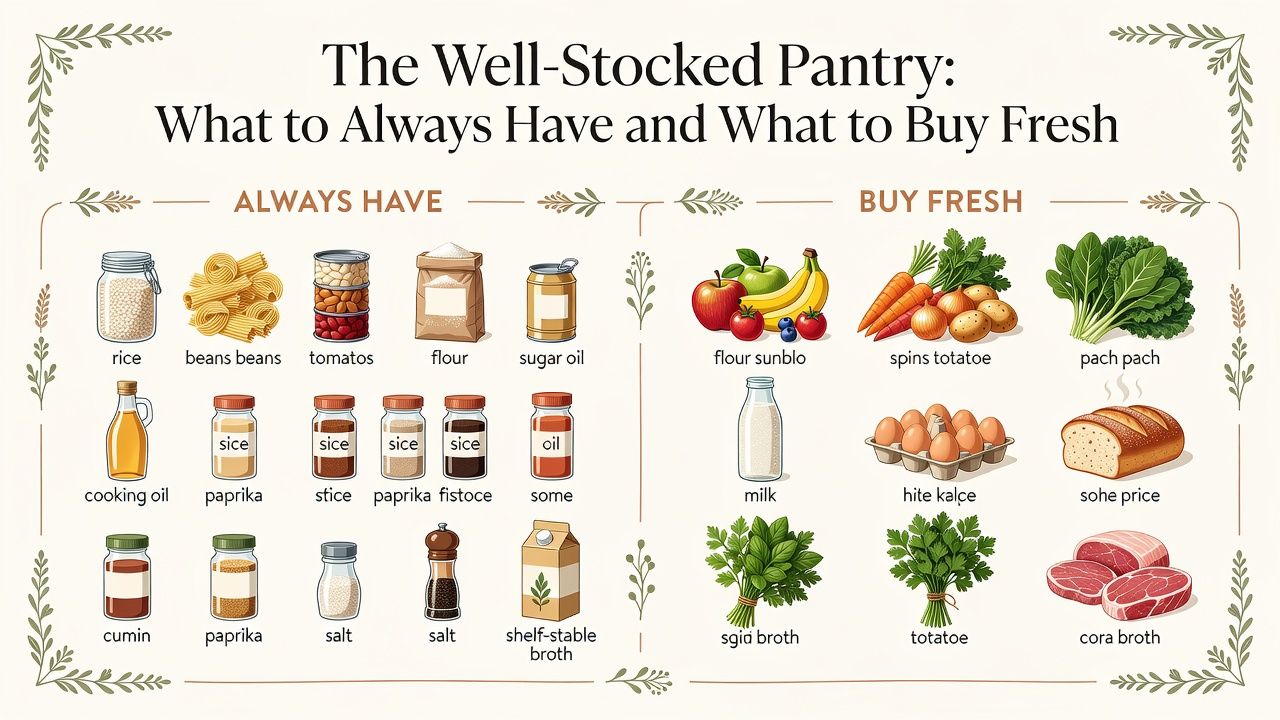
A handful of categories genuinely belong in long-term storage, because they’re stable for months to years, versatile across a huge range of dishes, and form the actual backbone of most cooking rather than a specialty ingredient reached for only occasionally. Grains and starches, rice, pasta, oats, and similar shelf-stable staples, keep for a year or more in a cool, dry, airtight container and underpin an enormous share of everyday cooking across virtually every cuisine on earth. Dried legumes, alongside their canned equivalents, are similarly durable and form the protein backbone of countless dishes at a fraction of the cost of most animal proteins, worth keeping in genuine quantity rather than as a token backup.
Canned goods generally, tomatoes, beans, coconut milk, tinned fish, keep for a long time, provide real culinary value rather than serving as a mere emergency fallback for a night when nothing else is available, and are worth keeping in genuine quantity rather than a token can or two pushed to the back of a shelf. Oils and vinegars, kept properly away from heat and light, last for months to a year or more and are foundational to virtually all cooking; it’s worth keeping at least one neutral cooking oil and one flavorful finishing oil on hand, alongside a couple of different vinegars for acidity and brightness. Whole spices and a core set of dried herbs round out the genuine long-term category, though as discussed further below, “long-term” for spices is a somewhat more limited window than most people assume when they buy a large jar expecting it to last indefinitely.
| Category | Realistic shelf life | Store |
|---|---|---|
| Rice, pasta, dried grains | 1–2+ years | Cool, dry, airtight container |
| Dried legumes | 1–2 years (best texture within a year) | Cool, dry, airtight container |
| Canned goods | 1–several years unopened | Cool, dry cupboard |
| Cooking oils | 6–12 months opened | Cool, dark, away from the stove |
| Vinegars | 1–2+ years | Cool, dark cupboard |
| Whole spices / dried herbs | Whole: 2–4 years; ground: 6–12 months | Cool, dark, airtight, away from the stove |
02The spice truth nobody wants to hear
Spices deserve their own dedicated section because the gap between how long they technically remain “safe” and how long they remain genuinely flavorful is large, and most kitchens are working with spices well past the point where they’re contributing much of anything meaningful to the finished dish. Ground spices lose their aromatic potency within roughly six to twelve months of grinding, sometimes faster depending on storage conditions, while whole spices, peppercorns, whole cumin seed, cinnamon sticks, whole cloves, hold their essential oils and aroma for considerably longer, often two to four years, because the intact structure protects the compounds that actually carry flavor from evaporating as quickly as they would once ground and exposed to more surface area.
The practical implications are worth acting on rather than just knowing abstractly and continuing to cook with whatever’s already in the cupboard regardless. Buy whole spices where practical and grind them as needed in a cheap dedicated grinder or a mortar and pestle; the flavor difference between freshly ground and long-stored ground spice is genuinely dramatic, often more noticeable than the difference between a cheap and an expensive spice purchased in the first place. Buy ground spices you use less frequently in small quantities rather than large jars that will sit half-used for years, since a large discount jar of a spice you use twice a year is false economy if most of it goes stale before you get through it. Store spices away from heat and light, the traditional rack mounted directly above the stove is, ironically, the single worst place to keep them, since the heat from cooking actively accelerates their decline every single time a burner is used nearby. And do a periodic honest smell test: a spice that smells like very little will taste like very little, and no quantity added to a dish compensates for a spice that’s already lost its aromatic punch entirely.
A quick pantry audit
Once a year, go through the spice cupboard specifically and smell each one. If it smells like little more than dust, it’s not contributing anything to your cooking — replace it or let it go rather than continuing to measure it into recipes on the assumption that it’s still doing something.
03What belongs in the fridge or freezer, not the pantry cupboard
Some items sold or perceived as pantry staples actually keep meaningfully better in the fridge or freezer, and this is a common source of accelerated spoilage that people don’t always realize is genuinely avoidable with a small change in habit. Whole-grain flours and any flour containing the oil-rich germ layer, as opposed to refined white flour, which lasts considerably longer at room temperature, go rancid faster than most people expect sitting in a warm kitchen cupboard, and keeping them in the fridge or freezer meaningfully extends their useful window; the same is true of nuts and seeds, whose natural oil content makes them prone to turning rancid within weeks to a couple of months at warm room temperature but which last many months longer refrigerated or frozen instead.
Nut butters, once opened, generally do better refrigerated for extended storage, though many people keep a current jar at room temperature for spreadability and simply don’t buy more than will be used within a reasonable window before that becomes a concern. Whole-grain rice, similarly, has a shorter reliable shelf life than white rice for the same oil-content reason discussed above and benefits from refrigerated or frozen storage if you’re not going through it quickly. This is a short but genuinely useful list to internalize, since treating these items exactly like their more stable pantry cousins is one of the more common, avoidable sources of spoiled or rancid-tasting ingredients quietly undermining an otherwise well-organized kitchen.
04What should always be bought fresh
Certain categories are genuinely better bought fresh, as needed, rather than stockpiled in advance, either because their quality degrades meaningfully with any storage time at all or because their whole culinary value depends on freshness in a way no amount of careful storage can fully preserve indefinitely. Fresh herbs are the clearest case: their aromatic value is substantially higher fresh than dried for the herbs where both forms exist, basil, cilantro, parsley, mint, and similar tender herbs in particular, and while proper storage, trimmed stems in a glass of water, loosely covered, refrigerated for the herbs that prefer cold, or left at room temperature for basil specifically, extends their useful window meaningfully beyond just tossing them in a bag and forgetting about them, they’re still fundamentally a buy-as-needed category rather than a genuine long-term stock item.
Most fresh vegetables and fruit, dairy, and fresh proteins obviously belong in this same buy-fresh category, and the practical skill worth developing here is not stockpiling but rather timing purchases to actual planned use, buying what you’ll genuinely cook within the coming few days rather than what looks appealing in the moment without a specific plan already attached to it. Bread is a borderline case worth calling out specifically: fresh bread is genuinely best fresh, staling within a couple of days at room temperature, but it freezes exceptionally well, sliced, with individual portions pulled out as needed, which means the practical strategy is buying or baking bread with the explicit intention of freezing the portion you won’t use within the first couple of days, rather than either buying only what you’ll use immediately, meaning frequent, inconvenient trips, or letting the excess go stale and wasted on the counter.
| Buy fresh, as needed | Why not stockpile |
|---|---|
| Fresh herbs | Aromatic value drops fast even with good storage |
| Fresh vegetables & fruit | Short useful window; best matched to a specific plan |
| Dairy | Perishable; quality and safety both time-limited |
| Fresh proteins | Short safe window unless promptly frozen |
| Bread | Stales within days — buy to eat fresh, freeze the rest |
05Organizing so the pantry actually gets used
A well-stocked pantry only delivers its value if you can actually see and reach what’s in it, and organization matters just as much as the stocking decisions themselves discussed above. Decanting dry goods into uniform, clear, airtight containers accomplishes several things at once: contents stay visibly trackable rather than hidden inside an opaque bag, everything stacks squarely rather than slumping into wasted shelf space, and freshness is generally better protected than in the original packaging, which is often not genuinely airtight once it’s already been opened once. Label containers with contents and, where relevant, a purchase or transfer date, since memory is unreliable and a labeled container removes the guesswork that otherwise leads to either premature discarding of something still perfectly good or, less often but more concerning, continued use of something that’s genuinely past its useful window.
First-in-first-out rotation is the single habit that does the most to prevent the “forgotten jar at the back” problem that drives a large share of pantry waste in most households: when unpacking new groceries, move existing stock to the front and place new purchases behind it, so that what’s used first is genuinely what’s been there longest rather than whatever happens to be most convenient to grab in the moment. This costs perhaps thirty seconds per shopping trip and meaningfully reduces the rate at which pantry items quietly expire unused at the back of a shelf, forgotten. Grouping by category rather than by whenever an item happened to be purchased, grains together, canned goods together, oils and vinegars together, makes both stock-taking and cooking meaningfully faster, since you’re not hunting across the whole pantry for items that logically belong together in the first place.
06The condiment shelf: a category worth its own scrutiny
Condiments occupy an odd middle ground between the long-term pantry core and the buy-fresh category, and they’re worth a specific mention because so many refrigerator doors end up hosting a slow-growing museum of half-used bottles, most opened once for a single specific recipe and never touched again afterward. A genuinely useful condiment shelf is shorter than most people’s actual collection: a good soy sauce or similar savory liquid seasoning, a mustard, a hot sauce, mayonnaise if it’s used regularly, and one or two vinegars beyond the cooking staples already covered above. Anything beyond that core, purchased for one specific dish and unlikely to be reached for again soon, is worth being honest about at the point of purchase rather than letting it join the permanent, ever-expanding collection by default simply because throwing away an unopened jar feels wasteful in the moment.
08Adjusting the pantry with the seasons
A pantry built around genuine cooking habits naturally shifts a little through the year, and it’s worth planning for that rather than treating the pantry as a fixed, static list decided once and never revisited. Winter cooking tends to lean harder on the long-simmered, warming end of the pantry, dried beans, grains, canned tomatoes, warming spices, while summer cooking leans toward lighter, fresher preparations where the pantry plays a smaller supporting role behind whatever fresh produce is at its peak that week. Buying a slightly smaller quantity of winter-heavy staples heading into summer, and topping back up as the weather turns again in autumn, is a small adjustment that keeps the pantry matched to what’s actually being cooked rather than carrying a static, unchanging inventory that’s only fully relevant for part of the year.
This seasonal awareness also helps with the freshness problem discussed throughout this guide, since a pantry item bought at the start of a season and used consistently through it is far less likely to sit forgotten for the better part of a year than one bought without any particular plan and left to its own devices on a shelf that isn’t regularly emptied and refilled with the rhythm of actual cooking.
09Building the pantry around how you actually cook
The final and most important principle is that a genuinely well-stocked pantry is built around your actual cooking habits, not around a generic list copied wholesale from an article, including, to be direct about it, this one. If your household cooks primarily Mediterranean- or Middle Eastern-influenced food, the essential long-term staples are chickpeas, tahini, good olive oil, and specific spice blends; if the household leans toward East or Southeast Asian cooking, soy sauce, rice vinegar, sesame oil, and specific aromatics and pastes take that same foundational role instead, and neither list is more objectively “correct” than the other. There’s no single universal pantry list that serves every household equally well, and forcing your kitchen to stock ingredients for cuisines you rarely actually cook, simply because a generic list recommended them, is exactly the kind of accumulation that leads to expired, unused jars taking up shelf space for years.
A useful exercise, worth doing honestly rather than aspirationally, is to look back over the last month of actual dinners cooked and note which pantry staples appeared repeatedly across multiple different dishes; those are the genuine core of your pantry and deserve to always be in stock and always be fresh. Anything that appeared once, for a single specific recipe, and hasn’t been touched since, is a candidate for buying fresh next time it’s genuinely needed rather than maintaining as permanent stock indefinitely. Reassess this periodically, since cooking habits shift over time with the seasons, with new interests, with changing life circumstances, and a pantry stocked to match last year’s habits rather than this year’s is quietly accumulating the same kind of unused, aging inventory the whole exercise was meant to prevent in the first place.
The genuinely well-stocked pantry, in the end, isn’t defined by how many items are on the shelf, it’s defined by the rate at which those items actually get used before they lose their value, and by how rarely a special trip to the store is needed to cook something genuinely good with what’s already there waiting. Get the long-term-versus-fresh distinction right, respect the real shelf life of spices in particular, keep the oil-rich items where cold actually protects them, and build the whole system around your real cooking habits rather than an aspirational or generic version of them borrowed from someone else’s kitchen. That combination produces a pantry that’s a genuine asset rather than a slowly accumulating, quietly expensive collection of good intentions gathering dust in the back of a cupboard.