Meal Planning & Household Economics
Freezing doesn’t damage food. Bad freezing does — and the difference comes down to speed, air, and portioning, none of which cost anything extra.
There’s a common and understandable prejudice against frozen food: that it inevitably comes out mushy, waterlogged, or bland compared to fresh, and that the freezer is a place food goes to become a worse version of itself rather than a genuine extension of a working kitchen. This prejudice is usually based on real experience, but the culprit is almost never the act of freezing itself. It’s freezer burn from inadequate wrapping, slow freezing that forms large, cell-rupturing ice crystals, poor portioning that forces an all-or-nothing thaw, and food left in the freezer so long it’s simply degraded through prolonged, unmanaged storage. Every one of these causes is avoidable with technique that costs nothing extra beyond a few minutes of attention at the point of freezing, before the food goes in rather than after something goes wrong.
Understood and used properly, a freezer is one of the most valuable tools in a cost-conscious, waste-conscious kitchen: it extends the life of food that would otherwise spoil, lets you take advantage of sales and seasonal abundance without losing the savings to spoilage, turns batch cooking into a genuine time-saving system rather than a one-week novelty, and rescues food that’s about to turn rather than letting it become waste at the last moment. This guide covers the actual mechanics of freezing well, why bad freezing happens and how to avoid it, what freezes well and what genuinely doesn’t, and the organizational habits that make a freezer a working larder rather than an archaeological site of forgotten, undated bags nobody wants to dig through.
01Why freezer burn happens, and how to actually prevent it
Freezer burn, the greyish, dried-out, texturally unpleasant patches that form on poorly stored frozen food, is caused by air contact and moisture loss, not by the freezing process itself in any fundamental way. When food is exposed to air inside the freezer, moisture at the surface slowly sublimates, converting directly from ice to vapor, into that air space, leaving the surface dehydrated, and this dehydrated surface is what gives freezer-burned food its characteristic dry, tough, off-flavor patches, even though the rest of the item may be perfectly fine underneath that damaged outer layer. The fix is almost entirely about minimizing the food’s exposure to air, and it’s simpler in practice than the underlying science explanation might suggest at first.
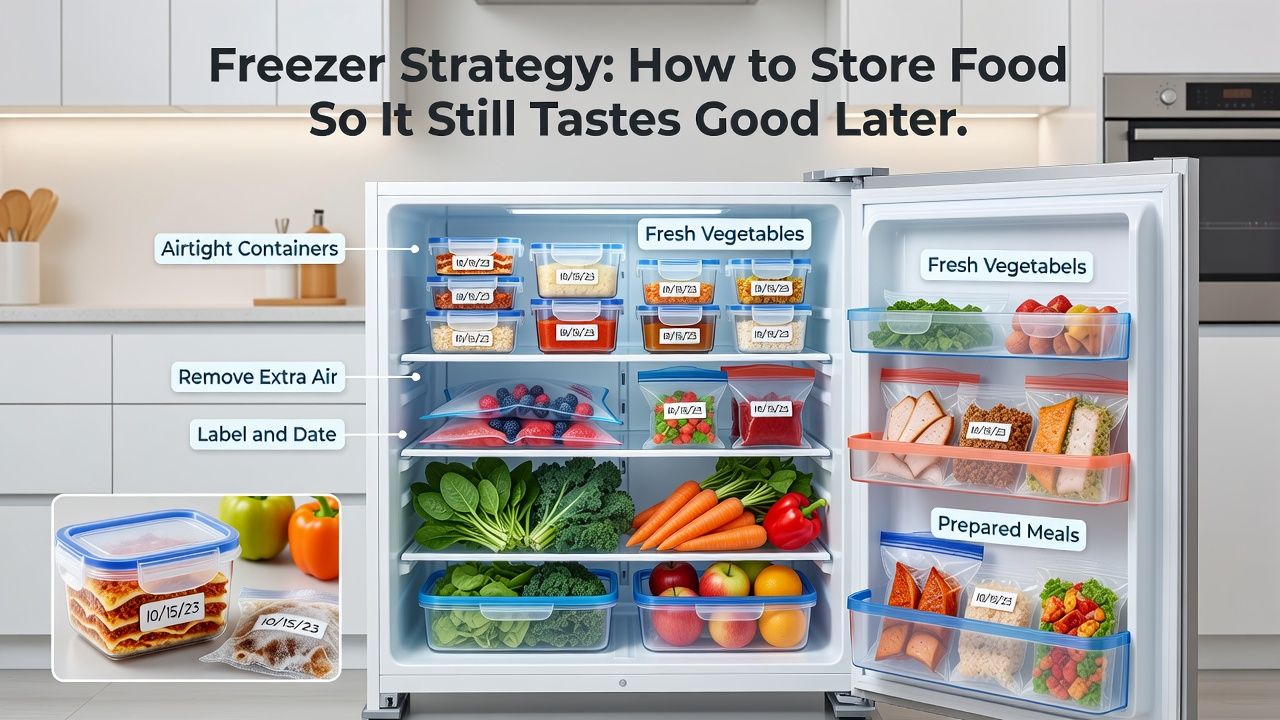
Removing as much air as possible from the packaging before sealing is the single most effective step: pressing air out of a freezer bag by hand before sealing it, using a vacuum sealer if you have one and are freezing in any real quantity, or simply pressing plastic wrap directly onto the surface of a food before adding an outer container, all accomplish the same goal of minimizing the air-to-food contact where sublimation actually happens over time. Double-wrapping or using a genuinely airtight container adds a further layer of protection, particularly for longer-term storage, and it’s worth the extra minute for anything you expect to keep for more than a month or two in the freezer. Using freezer-specific bags and containers rather than regular storage bags is worth the modest price difference, since freezer-grade plastic is genuinely thicker and less permeable to both air and moisture transfer than standard bags, and this difference compounds meaningfully over weeks or months of continuous storage.
The air-out trick
For a freezer bag without a vacuum sealer, zip it most of the way closed, insert a straw into the remaining gap, suck out the air, then quickly pull the straw out and seal completely. It sounds crude and works remarkably well — a genuinely useful zero-cost substitute for a vacuum sealer for most home freezing needs.
02Freeze fast: the ice-crystal problem
The second major cause of poor-quality frozen food is slow freezing, and it’s a more subtle mechanism than freezer burn but every bit as consequential for the food’s final texture once thawed. When food freezes slowly, the water inside its cells has time to form large ice crystals, and those large crystals physically rupture the cell walls as they form, which is why slowly frozen fruit, in particular, so often turns mushy and watery upon thawing, since the ruptured cells can no longer hold their structure or their moisture once the ice inside them eventually melts. Fast freezing produces many small ice crystals rather than a few large ones, and small crystals cause dramatically less cellular damage, which is why professionally flash-frozen food, and food frozen using the technique below, generally retains noticeably better texture than food frozen slowly in a crowded home freezer where airflow is limited.
The practical technique that addresses this at home is the flash-freeze or open-freeze method: spread food in a single layer on a tray, with pieces not touching each other, and freeze uncovered until solid before transferring to a bag or container for longer-term storage. This is standard practice for berries, chopped vegetables, cookie dough portions, and individual portions of many other foods, and it accomplishes two things at once, it freezes each piece quickly since it’s fully exposed to the cold air on all sides rather than insulated inside a thick block, and it prevents everything from freezing into one solid clump, which means you can pour out exactly the amount you need later rather than being forced to defrost an entire bag just to get at a single portion.
For liquids and larger items where flash-freezing individual pieces isn’t practical, freezing in relatively thin, flat layers rather than thick blocks achieves a similar speed benefit, since a flat bag of soup or stock freezes considerably faster than the same volume in a deep, narrow container, given how much more of the food’s surface area is in direct contact with the cold air or the freezer shelf itself. This is also, conveniently, the better shape for storage efficiency and faster thawing later, making flat-freezing close to a universal best practice for any liquid or semi-liquid food you’re planning to store for any length of time.
03What freezes genuinely well, and what doesn’t
Not every food freezes with equal success, and knowing the genuine limitations prevents disappointment and wasted effort spent freezing something that was never going to come out well in the first place. High-water-content vegetables eaten raw, lettuce, cucumber, celery, freeze very poorly for fresh eating, since the cell rupture described above leaves them limp and waterlogged upon thawing; they can still be frozen for cooked applications like soups, where texture matters far less than flavor, but they’re a poor candidate for anything meant to be eaten crisp afterward. Dairy-based sauces and anything relying on a smooth emulsion, mayonnaise, cream-based sauces, some custards, frequently separates or “breaks” upon freezing and thawing, becoming grainy or watery in a way that’s difficult to fully recover even with vigorous whisking after the fact, though this varies by specific formulation and some cream-based soups do freeze reasonably well if made with the eventual freeze in mind from the start.
Fried foods lose their crispness almost entirely upon freezing and reheating, becoming soft rather than crisp regardless of reheating method used afterward, though they can often be re-crisped somewhat in an oven or air fryer after thawing if crispness genuinely matters to the finished dish. Potatoes, particularly boiled or unprocessed raw potatoes, can develop an unpleasant grainy, watery texture when frozen, though this is less of an issue for potatoes that have been mashed with fat, which protects the texture somewhat, or that are destined for a soup where texture is less critical to the overall eating experience.
| Freezes well | Freezes poorly |
|---|---|
| Cooked grains, beans, most proteins | Raw high-water vegetables meant to be eaten fresh |
| Soups, stews, braises, stock | Cream- or mayonnaise-based sauces |
| Bread, sliced and portioned | Fried foods, for crispness |
| Berries and most fruit, flash-frozen | Raw or boiled potatoes (grainy texture) |
| Cookie dough, unbaked pastry | Whole eggs in shell (freeze them beaten instead) |
| Herbs, frozen in oil in ice-cube trays | Delicate salad greens generally |
On the positive side, the list of genuinely good freezer candidates is long and worth taking full advantage of rather than reserving the freezer for the occasional emergency loaf of bread. Cooked grains, beans, and most cooked proteins freeze and reheat very well, making them excellent batch-cooking candidates that hold their texture through the freeze-thaw cycle with minimal noticeable loss. Soups, stews, and braises, the very dishes that benefit most from long slow cooking in the first place, also tend to freeze exceptionally well and often taste just as good, sometimes arguably better, once the flavors have had time to meld further during frozen storage and the subsequent reheating. Bread freezes well when sliced and portioned, letting you take out exactly what’s needed rather than an entire loaf all at once. Herbs frozen in a little oil in ice-cube trays are a genuinely excellent way to preserve a glut of fresh herbs for cooking use, even though whole fresh herb leaves themselves don’t freeze well for garnishing purposes where appearance matters.
04Portioning: the habit that determines whether the freezer gets used
Poor portioning is a surprisingly common reason freezers end up underused despite good intentions at the time food was frozen: a large, undivided block of soup or a whole unportioned loaf of bread forces an all-or-nothing thaw, which means the freezer effectively becomes inconvenient to use for anything less than a full household meal, and food sits frozen far longer than intended because using it requires more commitment than the moment actually calls for on a given evening. Freezing in single-serving or family-meal-appropriate portions, decided in advance at the point of freezing rather than left for a future, less motivated version of yourself to figure out later, is one of the highest-value habits in this entire guide, and it costs nothing beyond a moment’s thought before sealing the container.
Muffin tins and ice-cube trays are genuinely useful portioning tools well beyond their obvious intended uses: small quantities of stock, pesto, tomato paste, chopped herbs in oil, or leftover wine can all be frozen in ice-cube-tray portions and then transferred to a labeled bag once solid, giving you small, precisely useful increments rather than being stuck with a large frozen block for something you only need a spoonful of at a time. For larger items like soups and stews, flat-freezing in labeled bags, as discussed above, has the added benefit that a frozen flat bag can be snapped or broken into smaller portions even after fully freezing, giving some flexibility even without perfect advance portioning at the time it went in.
05Labeling and rotation: the difference between a larder and a graveyard
A freezer without a labeling system reliably degrades into a collection of unidentifiable frosted bags within a few months, and the resulting uncertainty, is this still good, what even is this, how long has it been in here, is precisely what causes people to either throw out perfectly good food out of caution or, in some cases, use food that’s genuinely past a reasonable window because they simply lost track of when it went in originally. Label every single item with contents and the date it was frozen, without exception, using masking tape and a marker if nothing fancier is available; this is not optional if the freezer is meant to function as a real working tool rather than a place things quietly disappear into for months at a time.
Keeping a running inventory list, whether on a whiteboard on the freezer door or a note on your phone, updated each time something goes in or comes out, solves the “I forgot what’s in there” problem more completely than labeling alone, since it lets you see the whole freezer’s contents at a glance without opening the door and digging through frozen layers to find out. First-in-first-out rotation applies here exactly as it does in a pantry: place newer items behind or below older ones so what gets used first is genuinely what’s been in there longest. General guidance on safe freezer storage durations for different food categories, along with safe thawing methods, in the refrigerator, in cold water, or in the microwave, rather than at room temperature on the counter, is published by the USDA Food Safety and Inspection Service and at FoodSafety.gov, and it’s worth a genuine read, since it’s important to note that freezing keeps food safe indefinitely from a bacterial standpoint, but quality, flavor and texture, does decline over time regardless, which is the practical reason rotation and reasonable-length storage still matter even though safety per se isn’t really the primary concern once something is frozen solid.
06Freezer organization: making the physical space work for you
Beyond labeling, the physical arrangement of a freezer’s interior matters more than most people give it credit for, since a disorganized freezer defeats even the best labeling habits when nothing can actually be located without unpacking half the compartment first. Using stackable bins or baskets to group similar categories, all the meat together, all the vegetables together, all the prepared meals together, mimics the same category-grouping principle that works well in a pantry, and it means a specific search only requires pulling out one bin rather than excavating the entire freezer looking for a single bag. Standing flat-frozen bags upright, like books on a shelf, rather than letting them stack flat and bury each other, makes the whole collection visible at a glance from above, which is a small arrangement choice that pays back every single time the freezer door opens looking for something specific.
07Making it a genuine kitchen strategy, not just a storage habit
Used deliberately, a freezer becomes a genuine strategic tool for a cost-conscious, waste-conscious kitchen rather than simply a place to store leftovers reactively as they happen to occur. Take advantage of seasonal abundance and sales by buying and freezing in quantity when a specific ingredient is cheap and plentiful, rather than paying a premium for it out of season later, this applies well to fruit for baking and smoothies, and to proteins when they’re genuinely on a meaningful sale worth stocking up on. Freeze the excess whenever you cook a large batch of something that freezes well, treating batch cooking and freezer strategy as two halves of the same system rather than separate, unrelated habits; a large pot of soup or a big batch of a braise costs barely more effort to make in double quantity, with the second half going straight to the freezer for a future week when there’s no time or energy to cook from scratch.
Freeze food specifically to rescue it from spoiling rather than letting it go to waste, overripe bananas, herbs about to wilt, bread going stale, vegetables on the edge of turning are all better frozen, even if imperfectly, for cooking use rather than fresh eating, than thrown away without a second thought, and this single habit alone can meaningfully reduce a household’s food waste over the course of a full year. And keep a small, deliberate stock of genuine freezer staples, a bag of stock, a few individual portions of a favorite freezer-friendly meal, a bag of frozen vegetables, some frozen fruit for smoothies, specifically as an emergency backup for the nights when cooking from scratch simply isn’t happening, so that the freezer’s practical value as a safety net is genuinely realized rather than remaining purely theoretical.
The overarching lesson, worth restating plainly one more time: freezing itself doesn’t ruin food’s quality. Air exposure, slow freezing, poor portioning, and forgotten, unlabeled storage do, and every one of those causes has a specific, nearly free fix, press out the air, freeze in a thin layer or flash-freeze individual pieces, portion deliberately at the point of freezing, and label everything with contents and date. Applied consistently, a freezer stops being the place food goes to become disappointing and becomes exactly what it should be: a working extension of the pantry that saves money, reduces waste, and makes a genuinely good meal available on nights when there’s no time or energy to start entirely from scratch.