Food, Health & Wellness
What and when you eat in the evening genuinely affects sleep quality — modestly, and alongside far more powerful factors. Here’s what the evidence actually supports, without overselling it.
It’s worth being honest about scale before anything else in this article: what you eat for dinner is a real but modest factor in sleep quality, sitting well behind sleep schedule consistency, light exposure, stress levels, and underlying sleep conditions in terms of actual impact on how well you actually rest at night. No dinner recipe, however carefully composed, will fix a fundamentally disrupted sleep schedule or resolve a genuine sleep disorder on its own. What good evening eating habits can realistically do is remove some of the food-related friction that makes falling and staying asleep somewhat harder than it needs to be, which is a genuinely worthwhile thing to get right, just not a substitute for the bigger factors that matter considerably more in the overall picture.
This article covers what the evidence reasonably supports about evening eating and sleep: timing, specific foods and compounds that have real, if often modest, effects, and practical evening-meal habits worth adopting into an ordinary routine. It stays deliberately within what’s well established rather than reaching for dramatic claims, because the topic attracts a great deal of overconfident advice online, much of it promising more than food realistically delivers on its own. If you’re dealing with persistent sleep difficulty, that’s a conversation for a doctor, not a cooking article, food can help around the edges, but it isn’t a treatment for a genuine sleep problem, and this piece isn’t intended to suggest otherwise at any point.
01Timing matters more than most specific ingredients
Of everything covered in this article, meal timing has the clearest and most consistent evidence behind it. Eating a large, heavy meal too close to bedtime makes falling asleep harder for a straightforward physiological reason: digestion is an active metabolic process, and lying down with a full stomach shortly after a big meal can also contribute to acid reflux and general physical discomfort that interferes with settling into sleep, particularly for anyone prone to reflux in the first place. A commonly cited general guideline is to finish a substantial meal roughly two to three hours before bed, which gives the body meaningful time to move through the most active phase of digestion before you’re lying flat on a mattress for several hours.
The flip side matters just as much and is less often mentioned in the same breath: going to bed genuinely hungry can also disrupt sleep, since hunger itself is a physiologically activating state that can make falling asleep harder and can prompt waking partway through the night once the sensation becomes pronounced enough to register. This means the goal isn’t to avoid eating anything in the evening, but to time the main meal with reasonable buffer before bed and, if genuinely hungry closer to bedtime, to reach for a small, light snack rather than either a large meal or nothing at all. Consistency in meal timing, alongside consistency in sleep and wake times generally, is also worth mentioning here, since irregular eating patterns are one of several factors that can disrupt the body’s broader circadian rhythm, which governs sleep timing at a fundamental level beyond any single evening’s meal choices.
02The substances worth being deliberate about
Caffeine is the clearest and most evidence-backed dietary factor affecting sleep, and its effects last considerably longer than most people assume when they reach for a mid-afternoon coffee without much thought. Caffeine has a half-life of roughly five to six hours in most adults, meaning that a coffee consumed in the mid-afternoon can still have a meaningful amount of active caffeine in your system at bedtime, even if you don’t consciously feel “wired” or aware of any lingering effect. Sensitivity varies significantly between individuals based on genetics, habitual intake, and other factors, but a reasonable general guideline, reflected in guidance from health authorities including the Centers for Disease Control and Prevention, is to avoid caffeine for at least six hours before bed, and longer for anyone who notices they’re particularly sensitive to its effects on their own sleep. It’s also worth remembering that caffeine appears in more than just coffee: tea, chocolate, many sodas, and some over-the-counter medications all contain meaningful amounts that add up across a day without anyone tracking the cumulative total.
Alcohol is the other major substance worth being deliberate about, and it’s genuinely counterintuitive because of how it’s commonly perceived by people who reach for a nightcap specifically to help them sleep. Alcohol can help people fall asleep faster initially, since it has a sedating effect on the nervous system, but it measurably disrupts sleep architecture later in the night, reducing the amount of restorative deep and REM sleep and commonly causing waking in the second half of the night as the alcohol is metabolized and its sedating effect wears off. The practical upshot is that an evening drink may feel like it’s helping at the moment of falling asleep while actually producing a lower-quality, more fragmented night of sleep overall, a genuinely important distinction that’s easy to miss because the immediate subjective experience, falling asleep faster, doesn’t match the actual measured outcome, worse sleep quality across the full night.
| Substance | Effect on sleep | Practical guideline |
|---|---|---|
| Caffeine | Delays sleep onset; effects last hours longer than felt | Cut off at least 6 hours before bed |
| Alcohol | Speeds sleep onset, but fragments and lightens later sleep | Limit close to bedtime; be aware of the trade-off |
| Heavy, fatty meals | Slower digestion, discomfort, reflux risk lying down | Finish 2–3 hours before bed |
| Spicy or very acidic food | Reflux risk for sensitive individuals | Earlier in the evening if you’re prone to reflux |
| Excess fluids right before bed | Increased overnight waking to urinate | Front-load fluids earlier in the evening |
A note before going further
This article discusses food and sleep in general, informational terms. If sleep difficulty is a persistent, ongoing issue for you rather than an occasional inconvenience, that’s worth raising with a doctor rather than addressing through diet alone — there are many possible underlying causes, some of them unrelated to food entirely, and a healthcare professional is far better positioned to help than any article.
03What the specific-nutrient research actually shows
A great deal of popular sleep-and-food content promises specific foods as near-magical sleep aids, and it’s worth separating the modestly-supported claims from the genuinely overstated ones circulating widely online. Tryptophan, an amino acid found in turkey, dairy, eggs, and many other protein sources, and a genuine precursor in the body’s production of serotonin and subsequently melatonin, is real and biologically relevant, but the popular idea that a turkey dinner makes people specifically sleepy because of its tryptophan content is oversimplified; the drowsiness after a large holiday meal is more plausibly explained by the sheer quantity of food and carbohydrates consumed overall than by turkey’s tryptophan content specifically, since many other protein foods contain comparable or even higher amounts of the same amino acid.
Magnesium has research suggesting it may support sleep quality for some people, particularly those with an actual magnesium deficiency, and foods reasonably rich in it include leafy greens, nuts, seeds, and legumes, a modest, plausible, food-based way to support adequate intake rather than a guaranteed sleep intervention on its own. Melatonin itself, the hormone directly involved in regulating the sleep-wake cycle, is present in small naturally occurring amounts in some foods including tart cherries, and some research has looked specifically at tart cherry juice and modest sleep benefits, though the effect size in the research is generally small and results are mixed rather than dramatic and consistent across the available studies. Herbal preparations like chamomile tea have a long traditional use for relaxation and some limited supporting research, and are reasonable to include as part of a calming evening routine without expecting a strong, guaranteed effect from the tea itself.
The honest summary across all of these specific-nutrient claims: there’s real, biologically plausible substance behind several of them, but the effect sizes in the actual research are consistently modest rather than dramatic, and no single food or nutrient reliably transforms sleep quality on its own regardless of how it’s marketed. They’re worth incorporating as one small piece of a broader approach to good sleep, not relied upon as a primary solution, and it’s worth maintaining real skepticism toward any product or article promising a specific food or supplement as a dramatic sleep fix, since the underlying research rarely supports claims that strong once you actually look into the source studies.
04What a genuinely sleep-friendly evening meal looks like
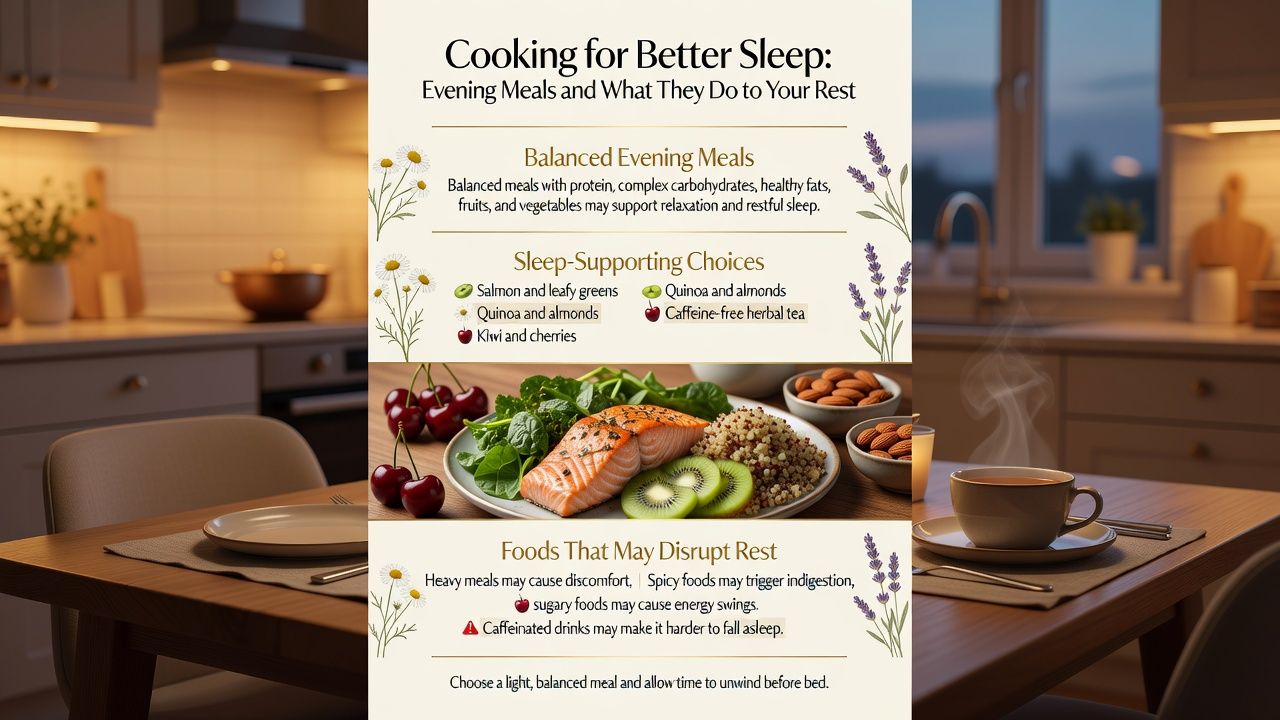
Bringing the evidence together into practical guidance, a sensible evening meal for sleep is moderate in size rather than very heavy, includes a reasonable balance of protein, complex carbohydrates, and vegetables rather than being extremely high in fat or very heavy and rich throughout, and is finished with enough buffer before bed, the two-to-three-hour window discussed above, to allow digestion to progress before lying down for the night. This isn’t a restrictive or unusual way of eating; it’s close to how a great many people already eat dinner, adjusted slightly for timing and portion size on nights when sleep quality matters more than usual, such as before an important day that requires being well-rested.
For anyone genuinely hungry closer to bedtime than the ideal window allows, a small, light snack is a better choice than either a large meal or going to bed hungry, something like a small portion of yogurt, a piece of fruit, a few nuts, or a slice of toast with a modest topping, rather than a substantial second meal that would defeat the purpose of the timing guidance entirely. Being mindful of spicy or very acidic foods in the evening is worth specific attention for anyone prone to acid reflux or heartburn, since these can trigger or worsen symptoms that are particularly disruptive when lying down for several hours, and shifting spicier or more acidic dishes to lunch rather than dinner is a simple adjustment for reflux-prone individuals specifically, not a universal recommendation that applies equally to everyone regardless of their own digestive tendencies.
| Evening choice | Better for sleep | Why |
|---|---|---|
| Meal size | Moderate, not very heavy | Faster, more comfortable digestion before bed |
| Timing | 2–3 hours before bed | Allows digestion to progress before lying flat |
| Late hunger | Small light snack, not nothing | Genuine hunger can itself disrupt sleep onset |
| Spicy/acidic food | Earlier in the day if reflux-prone | Reduces reflux risk while lying down |
| Fluids | Most consumed earlier in the evening | Less overnight waking to use the bathroom |
05A few genuinely useful, low-key recipes
Rather than presenting this as a set of prescriptive “sleep foods,” it’s more honest and more useful to think of a small rotation of moderate, comfortable evening meals that fit the timing and composition guidance above and that most households would enjoy regardless of any sleep angle attached to the recipe. A simple roasted or grilled protein, chicken, fish, tofu, or a legume-based option, with a moderate portion of a whole grain and a generous serving of vegetables covers the basic composition well without being unusual or restrictive in any noticeable way. A vegetable-and-bean soup with a slice of whole-grain bread is another good template: warm, comforting, moderate in size, and easy on digestion in the hours before bed. A simple grain bowl with roasted vegetables, a modest portion of protein, and a light dressing works well for the same reasons and reheats easily from batch-cooked components, tying naturally into a broader weeknight cooking strategy that doesn’t require special evening-only preparation.
For the evening wind-down itself, a small cup of caffeine-free herbal tea, chamomile, or a tart cherry-based drink if you want to include the modestly-researched compound discussed above, is a pleasant, low-risk part of an evening routine, more valuable for the calming ritual of preparing and drinking something warm than for any dramatic pharmacological effect the drink itself might provide. None of these recipes are unusual or restrictive; the point isn’t a special “sleep diet,” but rather applying sensible timing and moderate portioning to meals that are already reasonably balanced and enjoyable in their own right.
06Individual variation and why one-size guidance has limits
It’s worth acknowledging directly that individual variation in how food affects sleep is genuinely substantial, and general guidelines like those in this article are population-level starting points rather than fixed rules that apply identically to everyone. Some people can drink coffee at four in the afternoon and sleep perfectly well; others notice disruption from a single cup consumed at breakfast. Some people sleep fine after a large late dinner; others feel the effects of the same meal for hours afterward. Paying attention to your own specific patterns, perhaps informally over a couple of weeks, noticing what precedes a good night’s sleep versus a poor one, is more useful in the end than rigidly applying any general guideline regardless of how your own body actually responds to it.
07Keeping this in proportion
It’s worth ending where this article began: food is a real but modest factor in sleep quality, and the much larger factors are things like a consistent sleep and wake schedule, adequate exposure to natural light during the day, limiting screen exposure and bright light in the hour or so before bed, managing stress, having a genuinely comfortable and dark sleep environment, and getting regular physical activity throughout the week. Comprehensive, evidence-based guidance on healthy sleep habits generally is published by the CDC and the National Heart, Lung, and Blood Institute, and it’s worth reading these directly for the full picture of what actually influences sleep, rather than treating evening eating as the primary lever to pull.
Getting evening eating right, a moderate, reasonably balanced meal finished with a couple of hours of buffer before bed, mindful caffeine and alcohol timing, and a light snack rather than nothing if genuinely hungry later, removes a source of friction that can make falling and staying asleep somewhat harder than necessary, and that’s a genuinely worthwhile, low-effort thing to get right. But it’s one supporting piece among several larger ones, not a solution on its own, and anyone experiencing persistent, meaningfully disruptive sleep problems is best served by talking with a doctor rather than adjusting dinner recipes and hoping for a dramatic change that the evidence doesn’t really promise on its own.
A note on sleep and wellbeing: sleep difficulty can be uncomfortable and frustrating to deal with, and it’s a genuinely common experience shared by a great many people at some point. If you’re finding that sleep problems are affecting your daily life or mood in a significant, ongoing way, it’s worth reaching out to a healthcare professional, who can help identify what’s actually going on and find the right support, this is a sensitive topic worth taking seriously rather than trying to manage entirely alone through diet adjustments made without any professional input.