Food, Health & Wellness
Serving size is the number that quietly distorts every other number on the label. Get that one right first, and the rest becomes far more useful.
The Nutrition Facts label is one of the most useful, and most commonly misread, pieces of information available to a shopper standing in a grocery aisle deciding between two similar-looking products. Most of the misreading traces back to one specific number that people skip past on the way to the figures they actually care about: serving size. Every value below it, calories, fat, sugar, sodium, everything, is calculated per serving as defined by the manufacturer, not per package, and not necessarily matching what most people would actually eat in one sitting. A bag of chips that “contains” 150 calories per serving might legally define a serving as a small handful, with the bag holding three or four servings total, and someone who eats the whole bag while glancing only at the calorie figure printed largest on the front has consumed several times what they thought they were consuming.
This article walks through the label the way it should actually be read: serving size first, since it’s the multiplier that determines everything else on the panel, followed by the specific nutrients worth genuine attention, the ingredient list, which carries information the Nutrition Facts panel doesn’t capture on its own, and a few of the common ways labels are legally, if not always transparently, used to shape a first impression at the point of purchase. The U.S. label format was substantially updated in 2016 specifically to make it more useful and realistic, and the Food and Drug Administration maintains detailed, authoritative guidance on exactly what each section means, worth consulting directly for anything this article doesn’t cover in full depth.
01Serving size: the number that changes everything below it
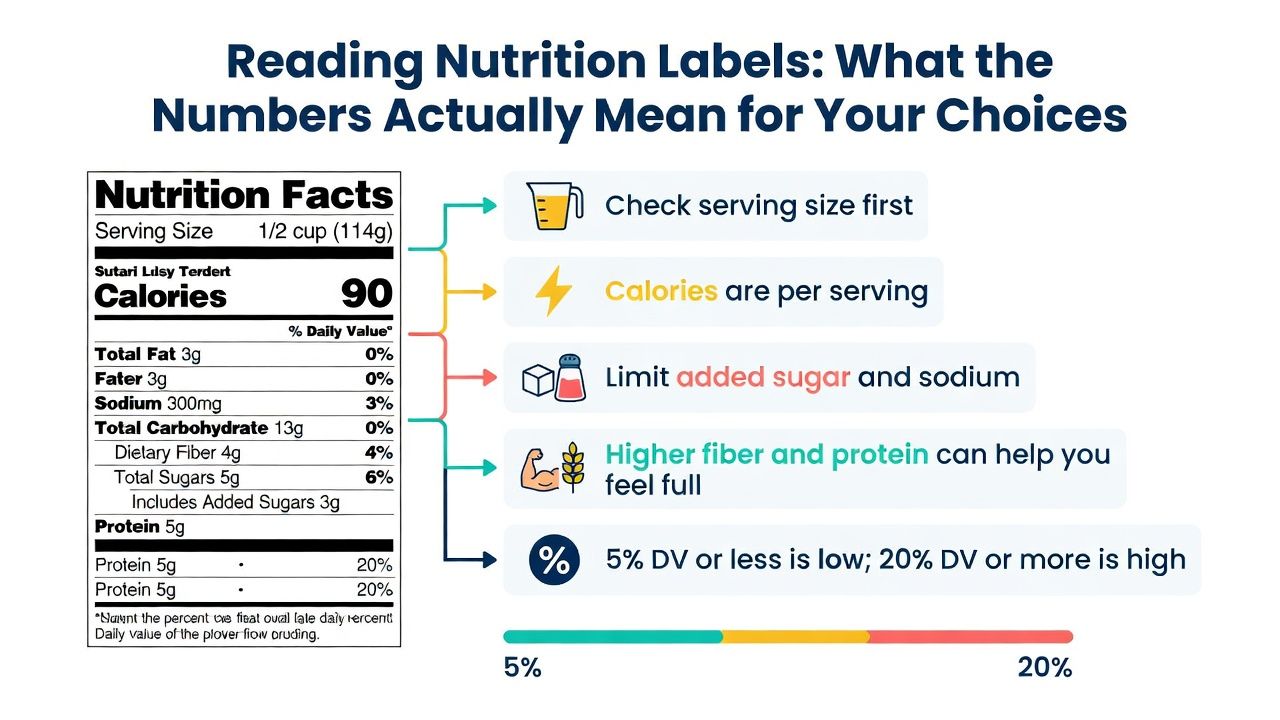
Every number on a Nutrition Facts label is calculated for the stated serving size, and the servings-per-container figure just below it tells you how many of those servings the whole package actually holds in total. The critical habit is checking both figures before looking at anything else, and then doing the mental multiplication for how much you’ll actually eat, rather than reading the calorie or fat figure in isolation and assuming it represents the whole package or your actual intended portion. A can of soup listing 80 calories per serving with “2.5 servings per container” contains roughly 200 calories if you eat the whole can in one sitting, which is very different information from what the headline 80-calorie figure suggests when read on its own without the multiplication step.
It’s worth knowing that serving sizes on U.S. labels are regulated based on typical amounts people actually eat, updated in the 2016 label revision specifically to better reflect real-world portions rather than idealized small ones that manufacturers had previously used to make products look lighter than they really were. Even so, “typical” is a population average, and it may not match what you personally eat in one sitting, particularly for foods commonly consumed in larger or smaller portions than the stated serving suggests, a jar of pasta sauce might state a serving size that’s less than half of what one person would actually pour over a single plate of pasta on an ordinary weeknight. The practical fix is simple: glance at the serving size, note the servings per container, and do a quick multiplication for your actual intended portion before drawing any conclusions from the numbers listed below it.
The two-second habit
Before reading any other number on a label, look at serving size and servings per container together. If you’re going to eat two servings’ worth, mentally double every figure below before drawing any conclusion. This single habit prevents the most common and most consequential label misreading.
02The percent daily value column, correctly understood
The %DV column, running down the right side of the label, is genuinely one of the most useful shortcuts on the whole panel once its actual meaning is understood properly, and one of the most commonly ignored simply because it looks less immediately meaningful than the raw gram figures printed beside it. The %DV tells you what percentage of a recommended daily amount, based on a standard 2,000-calorie reference diet, one serving of this specific food provides for that particular nutrient. A commonly cited general rule from FDA guidance is that 5% DV or less is considered low for a given nutrient, and 20% DV or more is considered high, a quick, genuinely useful screening tool for scanning a label at speed while standing in a store aisle without much time to deliberate.
This becomes practically useful in a specific, repeatable way: for nutrients you’re generally trying to limit, saturated fat, sodium, added sugar, looking for a low %DV is a reasonable quick screen; for nutrients you’re generally trying to get more of, fiber, vitamin D, calcium, potassium, iron, looking for a high %DV serves the opposite purpose entirely. It’s worth being aware that the reference 2,000-calorie diet is a population-level standard, not a personal recommendation tailored to any individual, so actual needs vary by individual factors including size, activity level, age, and specific health circumstances; the %DV is best used as a comparative tool between products, this cereal versus that cereal, rather than as a precise personal target to hit exactly every single day.
03Added sugars: the label’s most genuinely useful addition
The distinction between “total sugars” and “added sugars,” introduced in the 2016 label update, is arguably the single most useful piece of information added to the label in decades, because it resolves a genuine and previously confusing ambiguity that plagued nutrition labels for years before the change. Total sugars includes both naturally occurring sugars, the lactose in milk, the fructose in fruit, and any sugars added during processing, lumped together in one figure that on its own doesn’t distinguish a nutritionally very different situation: a plain yogurt’s total sugar figure, entirely from naturally occurring lactose, looks similar on paper to a flavored yogurt with a comparable total sugar figure that’s mostly added sugar, but these represent meaningfully different products from a nutrition standpoint, and the added sugars line is what actually separates the two.
Checking the added sugars line specifically, rather than relying on total sugars alone, is the single most useful habit for anyone paying attention to sugar intake, since it isolates exactly the sugar that’s been introduced during processing rather than penalizing naturally sugar-containing whole foods like fruit and dairy for their inherent, unavoidable composition. General dietary guidance on limiting added sugar intake is available from resources including Harvard’s Nutrition Source, and the added sugars line on the label is specifically the figure relevant to that guidance, not the total sugars figure that sits above it on the panel.
| Label element | What it tells you | Common misreading |
|---|---|---|
| Serving size | The basis for every figure below it | Assuming it matches the whole package or your actual portion |
| %DV | Roughly, whether a nutrient is “low” or “high” (5% / 20%) | Treating it as a precise personal target |
| Total sugars | All sugars, natural and added, combined | Penalizing whole fruit or dairy for natural sugar |
| Added sugars | Sugar introduced during processing specifically | Overlooking it in favor of the less specific total figure |
| Ingredient list order | Ingredients by descending weight | Not checking where sugar/oil sit in a long list |
04Sodium, fats, and fiber: what genuinely deserves attention
Sodium is worth genuine attention on a label because it accumulates quickly and quietly across a day of eating packaged and restaurant food, often reaching levels well above general dietary guidance without any single food seeming particularly salty in isolation when tasted on its own. Checking the %DV for sodium and being aware of the cumulative effect across multiple servings and multiple foods in a day, rather than evaluating any single food’s sodium content in isolation from everything else eaten that day, gives a more realistic picture of actual total intake. General guidance on sodium and its relationship to health is published by the American Heart Association, worth consulting for specifics, particularly for anyone managing blood pressure or a related condition.
Fats deserve a more nuanced reading than a simple “low fat is better” heuristic, since fat type matters considerably more than total fat quantity for most people’s actual health outcomes over time. The label distinguishes saturated fat and trans fat specifically, and current nutrition guidance generally treats these as the fat types most worth limiting, while unsaturated fats, not broken out as prominently on the label, but inferable as the remainder of total fat once saturated and trans fat are subtracted, are generally viewed favorably as part of an overall healthy dietary pattern. It’s also genuinely worth knowing that trans fat, even listed at “0g” on a label, can legally round down from a small nonzero amount under current labeling rules; checking the ingredient list for “partially hydrogenated oil” specifically is a more reliable way to confirm the genuine absence of trans fat than relying on the “0g” figure alone at face value.
Fiber is one of the nutrients worth actively seeking a high %DV for rather than merely tolerating its presence, since most people in Western dietary patterns consume meaningfully less fiber than general guidance recommends on a daily basis, and it’s associated with a range of favorable health outcomes across the research. Checking the fiber %DV and generally favoring higher-fiber options among otherwise similar products, whole grain versus refined versions of the same food, for instance, is a simple, genuinely useful comparative habit worth building into a regular shopping routine.
05The ingredient list: what the Nutrition Facts panel doesn’t tell you
The ingredient list, printed separately from the Nutrition Facts panel, carries genuinely important information the numbers alone don’t capture, and it’s worth reading as a matter of habit alongside the numeric panel rather than instead of it, treating the two as complementary sources rather than redundant ones. Ingredients are legally required to be listed in descending order by weight, which means the first few ingredients make up the large majority of the product by mass; a product listing sugar, corn syrup, or a specific oil among its first two or three ingredients is telling you something important about its actual composition that the summary numbers, taken alone, might not make as immediately obvious to a quick glance.
A long ingredient list with many unfamiliar, multi-syllable, or heavily processed-sounding additives is generally, though not universally, a reasonable proxy for a highly processed product, and comparing ingredient list length and composition between similar products, say, two brands of the same type of bread, or two brands of yogurt, is often more genuinely revealing about which is the less processed, more whole-food option than comparing their Nutrition Facts panels alone, since two products can have quite similar numeric profiles while differing considerably in how minimally or heavily processed they actually are in practice. This isn’t a call to avoid every ingredient with an unfamiliar name reflexively, some are entirely benign functional ingredients like specific vitamins or stabilizers that serve a legitimate purpose, but a long list dominated by items that don’t read like recognizable food is worth noticing as one input into a purchase decision alongside everything else.
06Front-of-package claims versus the actual label
Front-of-package marketing claims, “natural,” “made with real fruit,” “lightly sweetened,” “a good source of protein,” are regulated to varying and sometimes surprisingly loose degrees, and they can create an impression that doesn’t always match what the Nutrition Facts panel and ingredient list on the back actually reveal upon closer inspection. This isn’t necessarily deceptive in a legally actionable sense; it’s more that front-of-package marketing language is optimized to create a favorable first impression within the bounds of what’s legally permitted, which is a genuinely different goal from giving a complete, balanced nutritional picture at a glance. Treating any front-of-package claim as a prompt to check the actual panel and ingredient list, rather than as sufficient information on its own, is the single most protective habit against being misled by packaging design and marketing copy specifically crafted to create a certain favorable impression in a few seconds of shelf time.
Certain specific claims are worth particular skepticism because of how loosely they can legally be applied by manufacturers. “Made with real fruit” can legally describe a product containing a genuinely trivial amount of fruit alongside far larger quantities of added sugar and other ingredients that do the actual heavy lifting in the recipe. “Multigrain” describes a product containing more than one type of grain and says nothing whatsoever about whether those grains are whole or refined, a product can be entirely multigrain and entirely refined at the same time, which surprises many shoppers who reasonably assume “multigrain” implies “whole grain” when the two claims are actually unrelated to each other. Only “100% whole grain” or a similarly explicit statement, cross-checked against the ingredient list to confirm whole grain flour appears near the top, genuinely confirms that claim; “multigrain,” “wheat,” and even “made with whole grains” without a stated percentage can all describe products that are mostly refined flour underneath the marketing language.
| Claim seen | What to check instead |
|---|---|
| “Made with real fruit” | Where fruit sits in the ingredient list; the added sugars line |
| “Multigrain” | Whether “whole grain” flour appears near the top of ingredients |
| “Lightly sweetened” | The actual added sugars grams, per your real portion |
| “Natural” | The ingredient list — the term has limited regulatory meaning |
| “0g trans fat” | Ingredient list for “partially hydrogenated oil” |
07Comparing products fairly across a category
A specific skill worth developing beyond reading a single label in isolation is comparing two or more similar products fairly against each other, since this is where labels actually pay off most in daily grocery decisions. The trap to avoid is comparing raw numbers across products with different serving sizes without adjusting for that difference first, a cereal listing 120 calories per 30-gram serving is not automatically lower-calorie than one listing 150 calories per 45-gram serving, since the second is actually the more calorie-efficient option once normalized to the same weight. Many labels now include a “per 100g” or similar standardized figure alongside the per-serving numbers specifically to make this kind of comparison easier, and it’s worth looking for that standardized column when it’s available rather than relying solely on the manufacturer’s chosen serving size, which can vary considerably between competing products in ways that make a fair comparison harder than it should be.
08Putting it together: a realistic reading routine
Nobody realistically performs a full forensic reading of every label on every shopping trip, and a workable routine needs to be quick enough to actually get used consistently over months and years of ordinary shopping rather than abandoned after a single enthusiastic attempt. A reasonable practical sequence: check serving size and servings per container first, and do the mental math for your real portion; scan the %DV column for sodium, saturated fat, and fiber as quick low/high screens; check the added sugars line specifically rather than total sugars; and glance at the first few ingredients on the ingredient list to see what actually makes up the bulk of the product by weight. This entire sequence takes well under a minute once it’s a practiced habit, and it captures the large majority of what’s genuinely useful on the label without requiring a nutrition degree or an unreasonable amount of time standing in the aisle while other shoppers wait for the trolley to move.
It’s worth closing with a broader point of perspective: nutrition labels are a genuinely useful tool for comparing packaged products against each other and understanding what’s actually in something, but they’re not a complete framework for healthy eating on their own, and whole, unprocessed foods like fresh produce, plain grains, and simple proteins mostly don’t carry Nutrition Facts labels at all, precisely because they’re single ingredients rather than manufactured products assembled from a recipe. A diet built substantially around foods that don’t need a label, supplemented by informed, label-literate choices for the packaged foods that do fill in the rest, is a more complete approach than treating label literacy alone as the whole picture of healthy eating. For genuinely personalized nutrition questions, particularly around a specific health condition, a registered dietitian or a doctor is a far better resource than any general guide, including this one.