Kitchen Renovation & Home Improvement
The showroom sample never tells you how a material behaves after five years of actual cooking. Here’s what each one is really like to live with.
A countertop showroom is designed to sell you a material at its absolute best moment: freshly polished, perfectly lit, never having met a hot pan, a squeeze of lemon, or a decade of daily knife contact. The gap between that showroom slab and the same material five years into real kitchen life is where most countertop dissatisfaction lives, and it’s almost entirely avoidable with a bit of honest research before you commit to a material that costs thousands of dollars and is genuinely disruptive to replace once installed and sealed against the cabinets and sink.
The right countertop material isn’t the “best” one in the abstract — it’s the one whose particular strengths and particular weaknesses match how you actually cook and how much maintenance you’re honestly willing to do, week after week, for as long as you live with that counter. A household that cooks intensely, cuts directly on surfaces out of habit, and cooks with a lot of acidic ingredients has a very different ideal material from a household that cooks lightly and prioritizes a specific look above all else. This guide walks through the major materials with attention to what actually happens to them in daily use, not just their specifications on a sample card in a showroom.
01Quartz (engineered stone): the default for a reason
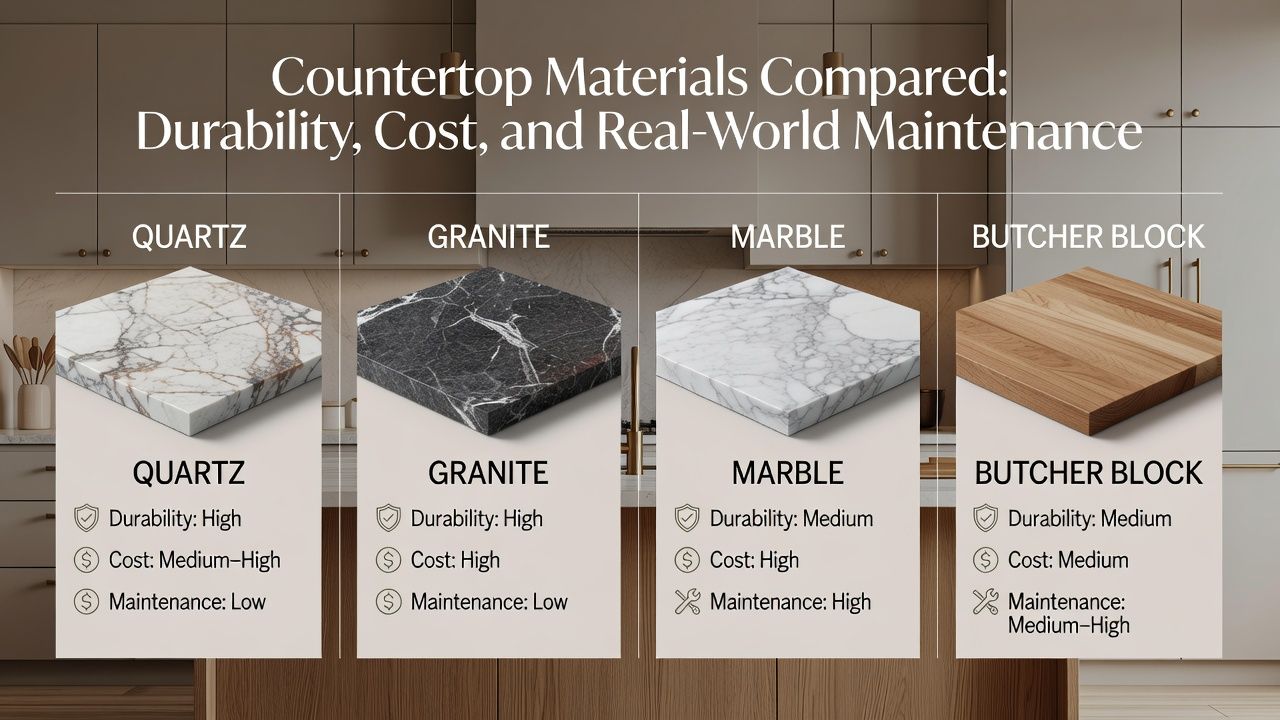
Engineered quartz has become the default recommendation for a great many kitchens, and the reasons are practical rather than purely aesthetic. It’s manufactured from crushed quartz combined with resin binders, which means — unlike natural stone — it’s non-porous straight out of the factory, requires no periodic sealing, and resists staining from the everyday offenders like wine, oil, coffee, and tomato sauce far better than most natural stones do without diligent, ongoing maintenance. It’s also more consistent in appearance than natural stone, since it’s engineered rather than quarried, which some people love for predictability and others find slightly less interesting than the genuine variation of real stone pulled from the ground.
The real-world caveats matter more than the marketing suggests. Quartz is heat-resistant but not heat-proof, and direct contact with a very hot pan can cause discoloration or, in worse cases, cracking — the resin binder is the vulnerable component, since it behaves differently under heat than the mineral quartz itself does. Trivets are not optional with this material despite frequently being marketed as heat-resistant; treat “heat-resistant” as “more heat-tolerant than some alternatives,” not as “immune to hot pans,” and you’ll avoid the single most common complaint quartz owners eventually raise. It’s also not entirely stain-proof under prolonged exposure — a spill of red wine or turmeric left sitting for hours rather than wiped up can occasionally leave a faint mark, particularly on lighter colors, though this is far less common than with unsealed natural stone. Direct sunlight over years can cause slight color shift in some formulations, which is worth asking about specifically if you’re installing near a large sun-facing window that gets strong afternoon light for much of the year.
| Material | Heat tolerance | Stain resistance | Maintenance |
|---|---|---|---|
| Quartz | Good, not heatproof | Very good | None — no sealing needed |
| Granite | Excellent | Good once sealed | Periodic resealing |
| Marble | Good | Poor — etches from acid | Regular resealing; accepting patina |
| Butcher block | Poor — scorches | Fair with oiling | Regular oiling; sanding over time |
| Stainless steel | Excellent | Excellent | Wipe down; scratches show |
| Concrete | Excellent | Fair once sealed | Periodic resealing; hairline cracks possible |
| Laminate | Poor | Good | Minimal, but not repairable if damaged |
02Granite and marble: natural stone, real differences
Granite and marble get grouped together as “natural stone” often enough that people assume they behave similarly. They don’t, and the difference matters enormously for kitchen use specifically, as opposed to, say, a bathroom vanity that sees far less acid and heat contact over its lifetime. Granite is extremely hard, genuinely heat-resistant — within reason, you can set a hot pan directly on it without damage, though this still isn’t universally recommended by installers who’d rather you develop the trivet habit regardless — and reasonably resistant to scratching from normal knife contact, though cutting directly on it will still dull your knives faster than a cutting board would over time. It’s porous and needs periodic sealing, typically every one to three years depending on the specific stone and how it’s used, but once properly sealed, it handles the everyday abuse of a working kitchen better than almost any other natural material available.
Marble is where the trade-off becomes serious, and it’s worth being extremely honest about before installing it, because it’s a common source of buyer’s remorse that shows up within the first year rather than fading with familiarity. Marble is calcium carbonate, and it reacts chemically with acid — lemon juice, vinegar, wine, tomato — leaving dull, etched marks that sealing does not prevent, because the reaction happens at the chemical level of the stone itself, not merely on a surface film that sealant can protect against. Anyone installing marble needs to make a genuine decision, not a hopeful assumption, about whether they can live with this: some people embrace the etching and staining as a natural “living patina” that develops character over years, particularly common in older European kitchen traditions, and genuinely love how it ages and softens over time. Others find every new mark disappointing and regret the choice within the first year of living with it. There is no maintenance routine that eliminates this trade-off — it’s inherent to the material itself — so the honest question is which camp you’re actually in, not whether you can find a sealant that promises otherwise, because none genuinely does.
A useful compromise some households choose is marble on a lower-use surface — a baking station or a bar area — while using a more forgiving material on the primary cooking and prep counters, getting the visual and tactile appeal of marble somewhere it’s seen and touched without exposing the entire kitchen’s primary work surface to constant acid contact from daily cooking.
03Butcher block: warm, forgiving, and needs real commitment
Wood countertops offer something none of the stone or engineered materials do: warmth, both visually and literally, and the ability to cut directly on them without ruining a knife, though a dedicated cutting board is still better for the wood’s longevity and your hygiene routine even so. Butcher block develops a genuinely appealing patina with age when properly maintained, and minor surface damage — scratches, small burns, water marks — can often be sanded out and re-oiled, which is a maintenance capability no stone or engineered surface offers at all; a stained or scorched quartz counter is stained or scorched permanently, while a wood counter can, within limits, be genuinely restored to something close to its original condition.
That restorability comes at the cost of ongoing commitment that’s easy to underestimate before actually living with it day to day. Wood needs regular oiling — food-safe mineral oil or a dedicated butcher block conditioner, typically monthly at first and less frequently once the wood is well-conditioned — and skipping this leads to drying, cracking, and reduced water resistance over time, undermining the very qualities that made the material appealing in the first place. It scorches from hot pans, so trivets are genuinely mandatory, not optional in the way they might be with a hardier material. Water left standing around a sink area can cause the wood to swell, warp, or develop dark staining if not wiped up reasonably promptly, which makes wood a poor choice directly around a sink basin — many wood-counter kitchens use a different material specifically around the sink for this reason — and a better choice as an accent surface elsewhere, such as an island or a baking-focused section of counter well away from the daily splash zone.
The honesty test for high-maintenance materials
Before choosing marble or butcher block for a primary work surface, ask honestly: have you kept up a monthly maintenance task consistently for a year in the past? If the honest answer is no, choose a lower-maintenance material for the main counter and reserve the high-maintenance one, if you still want it, for a smaller accent area you’re more likely to actually tend to.
04Stainless steel: the professional’s choice, and why
Stainless steel is the material professional kitchens actually use, and the reasons translate reasonably well to home kitchens for anyone willing to accept its one significant aesthetic limitation. It’s essentially indestructible under normal use: fully heat-resistant, a hot pan does nothing to it whatsoever, non-porous and therefore stain- and bacteria-resistant without any sealing ever required, and impervious to acid, so lemon and wine and tomato sauce have no effect on it at all regardless of how long they sit before being wiped away. It’s also fully hygienic in a way porous natural materials, even sealed, can’t quite match, which is precisely why it’s the industry standard in commercial food service kitchens worldwide.
The trade-off is purely cosmetic but genuinely significant for many households: stainless steel scratches, and every scratch is visible and permanent — a fine matte or brushed finish hides them better than a mirror-polished one, and this is worth specifying explicitly when ordering rather than assuming any stainless finish behaves the same way. It also dents under a genuinely hard impact, and it shows fingerprints and water spots readily, requiring more frequent wiping than most other materials to look consistently clean rather than smudged and dull. Some people embrace the accumulating scratches as evidence of a well-used, well-loved kitchen, in much the same spirit as those who embrace marble’s patina; others find the look untidy regardless of how functional the material genuinely is underneath. It’s worth handling a scratched sample, not just a pristine one, before committing to a full kitchen’s worth of it.
05Concrete, laminate, and the budget-conscious options
Concrete countertops occupy an interesting niche: fully customizable in shape, color, and finish, including integrated sinks and drain boards poured as a single continuous piece, genuinely heat-resistant, and capable of a distinctive, industrial-modern look no other material quite replicates convincingly. The real-world caveats are worth knowing before committing: concrete is porous and needs sealing, typically more frequently than granite, and even sealed it can still stain from prolonged exposure to acidic or oily substances left sitting on the surface. It’s also prone to developing hairline cracks over time as it cures and settles further after installation, a genuine and expected part of the material’s character — a well-made slab from an experienced fabricator handles this gracefully, with cracks that read as texture rather than failure, but a poorly executed pour from an inexperienced installer can crack in ways that look like a genuine defect rather than character. This is a material where fabricator experience matters enormously, more than with most other options, and it’s worth seeing a specific fabricator’s completed work in person, ideally a few years old rather than freshly finished, before committing to this specific material for a whole kitchen.
Laminate is the honest budget choice, and it deserves more respect than it typically gets in renovation conversations dominated by more expensive materials. Modern laminate has improved substantially in appearance, with realistic stone and wood patterns that photograph convincingly and, in many cases, are difficult to distinguish from the real thing at a casual glance, and it’s genuinely stain- and scratch-resistant for everyday use at a small fraction of the cost of any material discussed above. The real limitation is that damage — a deep scratch, a burn from an unprotected hot pan, a chip at an edge or seam — cannot be repaired or refinished the way stone can be re-polished or wood can be sanded; a damaged laminate counter needs to be replaced in that section, not restored to its original condition. For a starter home, a rental property, a secondary kitchen, or simply a tight budget where the money is better spent on cabinetry or appliances, laminate is a legitimately sound choice rather than a compromise to feel embarrassed about, and it’s worth resisting any social pressure that suggests otherwise.
06A note on porcelain and solid surface materials
Two further materials are worth knowing about even though they’re less commonly discussed than the six above. Large-format porcelain slabs, increasingly popular in recent years, offer excellent heat resistance, very strong stain and scratch resistance, and a genuinely wide range of finishes that can convincingly mimic stone or concrete at a thinner, lighter overall profile than natural stone requires. Their main drawback is a genuine risk of chipping at edges and corners under a sharp impact, since the material’s hardness, which makes it so scratch-resistant across the flat surface, also makes it somewhat brittle at vulnerable edge points, and repairing a chip is more difficult and less visually seamless than repairing many other materials on this list.
Solid surface material, an engineered acrylic-based product, offers a genuinely useful property none of the others do: seamless installation, where joints between pieces can be sanded and polished to be essentially invisible, and any scratches or minor burns can be sanded out much like butcher block, restoring the surface without full replacement. It’s softer than quartz or stone, more prone to scratching from knives and heat damage from very hot pans, but its repairability makes it a genuinely practical, low-maintenance-in-the-repair-sense choice for households that want an integrated, seamless look, particularly around sinks, without the ongoing sealing schedule that natural stone requires.
07Matching the material to how you actually cook
The most useful exercise before choosing is an honest inventory of your own habits rather than your aspirations for the kitchen you’d like to have. Do you cook with acidic ingredients — tomato sauce, citrus, wine reductions — frequently and casually, wiping up spills whenever you happen to notice them rather than immediately after they occur? That points away from marble and toward quartz or granite instead. Do you set hot pans down directly on the counter out of habit, even when you know better and mean to grab a trivet? That points toward granite, quartz, or stainless steel over butcher block or laminate, both of which will show that habit’s consequences within a season. Are you realistically going to do a monthly oiling routine, or will good intentions fade after the first few months once the novelty of a new kitchen wears off? That answer should genuinely decide whether butcher block belongs on your primary counter or as a smaller accent piece elsewhere in the room.
It’s also worth being honest about how you feel toward visible wear generally, since this is as much a personality question as a practical one. Some people find a developing patina — on wood, on marble, even on stainless steel — charming evidence of a kitchen that’s genuinely lived in and used; others find every mark a small, persistent irritation they notice every time they walk past it. Neither reaction is wrong, but they point toward very different material choices, and choosing a high-character, high-maintenance material while having the second temperament is one of the most common and most avoidable sources of buyer’s remorse in kitchen renovation, discovered only after thousands of dollars have already been spent and the material installed.
A final practical note: whichever material you choose, budget for proper installation from an experienced fabricator, since seams, edge finishing, and sink cutouts done poorly can undermine even the best material’s performance and appearance regardless of how well-suited the material itself was to your needs. Ask to see a fabricator’s completed installations in person, not just photographs on a website, and ask specifically about their experience with the material you’re choosing — concrete and natural stone in particular reward genuine specialization over general contracting experience. Get maintenance instructions specific to your exact slab or product in writing at installation, since sealing schedules and cleaning product recommendations vary between suppliers even within the same material category, and following generic advice for the wrong specific product can do more harm than good over time.
There’s no single correct answer among these materials — each one represents a genuine, defensible trade-off between durability, maintenance, cost, and character, and the right choice depends entirely on matching those trade-offs honestly to your own habits rather than to what looked best under showroom lighting on the day you happened to be shopping. Spend some time with real, lived-in examples of each material you’re considering if you can — a friend’s five-year-old counter, or a rental unit you’ve stayed in, tells you far more than a fresh sample ever will — and choose based on how you actually cook, not the kitchen you’d like to photograph for the day the renovation finishes.